A multi-language travel proposal is a quote you send in the language your client actually reads, not a best-effort English document they have to decode. If you sell to international travelers, this is not a nicety: it is the difference between a proposal that feels built for the client and one that feels forwarded. I spent a decade running a tour operation that quoted travelers across Europe and Asia, and the pattern never changed. The proposals we localized properly closed faster, with far fewer “can you clarify this part” emails, than the ones we left in English and hoped for the best.
This guide covers the part nobody writes about: not whether to translate, but when it is worth the effort, what to translate, what to leave untouched, and how to keep one proposal in sync once it exists in two or three languages.
Why a multi-language travel proposal changes how the client decides
When a client reads a proposal in their own language, they spend their attention on the trip. When they read it in a second language, they spend part of that attention translating, and every unit of attention that goes to translation is a unit that does not go to picturing themselves on the trip. That is the quiet cost of sending the wrong language. It rarely loses you the booking outright. It just makes the client hesitate, and hesitation is where bookings go to die.
There is also a trust signal at work. A traveler in Munich or Tokyo who receives a thoughtful proposal in German or Japanese reads one message before they read a single word of the itinerary: this agency took me seriously. You are asking a stranger to wire a deposit for a trip that does not exist yet. Anything that says “we work with people like you, all the time” lowers the risk they feel. Language is the most visible version of that signal you can send.
None of this means you translate everything for everyone. It means you treat language as part of the sale, not as a formatting step you bolt on at the end.
When localizing is worth it, and when it is not
Localizing a proposal takes real time, so spend it where it moves the booking. A few questions decide it:
- What is the client’s comfort language? Not the language they can get by in, the one they relax in. A client who emails you in careful, correct English may still decide in their mother tongue. If you know their comfort language and it is not yours, that is the strongest reason to localize.
- How much is the trip worth, and how long is the decision? A high-value, slow-decision trip (a honeymoon, a milestone anniversary, a multi-week itinerary) earns the effort. A quick weekend booking from a repeat client usually does not.
- Who is the proposal really for? Sometimes the person paying is not the person reading. A couple where one partner handles logistics in English and the other makes the emotional call in Italian is a localize-it situation, even though all your emails were in English.
The honest answer is that you will not localize most proposals, and you should not. A repeat B2B partner who works with you in English every week does not need a translated quote, and producing one just slows you both down. The skill is matching the effort to the moment, not translating on reflex.
What to translate, and what to leave exactly as it is
This is where most first attempts go wrong. Localizing a proposal is not “run the whole document through a translator.” Some things must change language and some things must never change, and mixing those up creates the exact confusion you were trying to avoid.
Translate the parts the client reads to understand and to feel: the day-by-day descriptions, the inclusions and exclusions, your cover note, the payment and cancellation terms, the section headings. These carry both the meaning and the mood, and they are where a natural translation earns its keep.
Leave these alone, in the original:
- Proper nouns. Hotel names, restaurant names, your agency name, the names of guides and venues. A translated hotel name is useless at check-in and can read as an error. If the property is “Hôtel du Lac,” it stays “Hôtel du Lac” in every language.
- Booking references, confirmation codes, and supplier identifiers. These are keys, not words. Translating them breaks them.
- The numbers that mean money or time, which you keep but double-check for format. A date written 03/04 means March 4 to an American and April 3 to most of Europe. A price with a comma as the decimal separator reads differently across markets. Localizing is as much about number and date formats as about words.
When I was quoting Japanese clients, the single most common mistake my team made early on was translating venue names into English “for clarity.” It did the opposite. The client would arrive at a hotel whose name on their proposal did not match the sign on the building. Keep the real-world strings real.
Machine translation is a draft, not a deliverable
Auto-translation has gotten good enough that it is tempting to treat it as the finished product. Do not. It is an excellent first pass and a dangerous final word, for reasons specific to our industry.
Travel language is full of terms that mean something precise to a professional and something vague to a general-purpose translator: half-board, transfer, FIT, net rate, allotment. A machine will often render these literally, and the result is a quotation that reads as slightly off to a native speaker, which undercuts the premium feel you are charging for. Worse, the lines most likely to be mistranslated are the ones that carry consequences: the payment schedule, the cancellation policy, what is and is not included. An error there is not a typo, it is a dispute waiting to happen.
The rule I settled on, and still recommend: a fluent or native speaker reviews anything client-facing before it goes out, with extra attention on the money and logistics lines. You do not need a certified translator for a leisure itinerary. You need someone who actually speaks the language reading it once, out loud if possible, to catch the phrasing a machine cannot feel. Machine-draft, human-review is the workflow that keeps both speed and credibility.
Keep one proposal, not five versions of it
Here is the operational trap that catches agencies the moment they start localizing: version drift. You send the French version, the client asks to swap one hotel and add a day, and now you have to change the master, re-translate the affected sections, re-export, and re-send. Do that across two or three languages and a couple of revision rounds, and you will eventually send a client a proposal where the price in one place does not match the price in another. That mistake costs you the trust the translation was supposed to build.
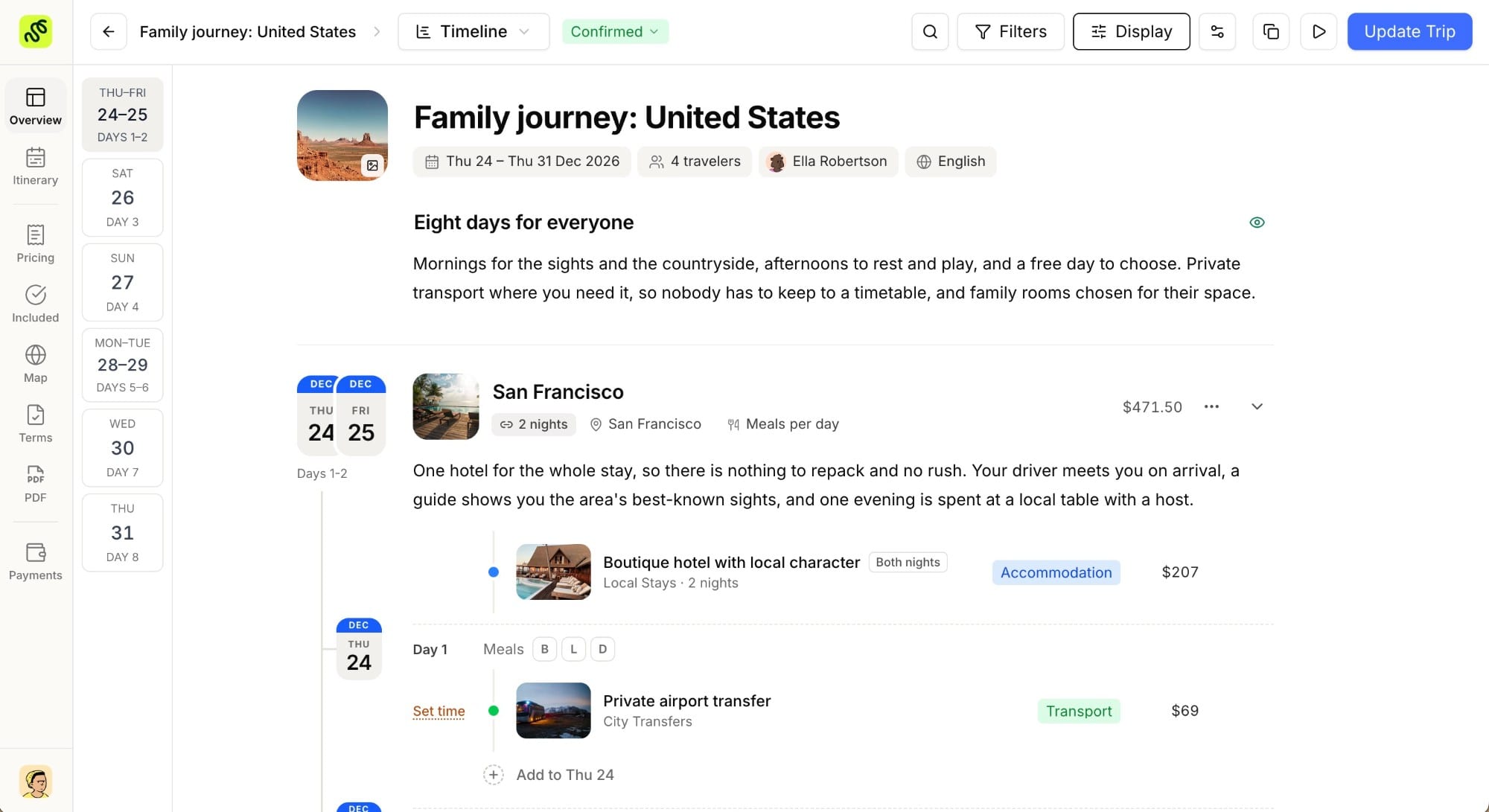
Static files make this worse, because each language is a separate PDF with its own copy of every number. The fix is structural, not clerical: build the trip once and generate the client-facing version in their language from that single source, so there is one set of facts and many presentations of it. A live itinerary builder does exactly this. You edit the itinerary once, and the client’s link reflects the change instantly, in their language, with no re-export and no stack of files to keep straight. That is the difference between a proposal that is a living link and one that is a frozen document you have to rebuild every time something moves.
This is the part of multi-language proposals that is genuinely a tooling problem rather than a writing one. TravelBuilderPro generates proposals in any of 66 languages from a single itinerary, and how many you enable for your agency depends on your plan, so the version-drift problem mostly disappears: one itinerary, one update, the client’s language applied on top. If you want the specifics of what each plan includes, the pricing page has the full breakdown.
A workflow for your next multilingual proposal
- Build the itinerary once in your working language, with the structure finished before you think about translation.
- Decide the client’s comfort language up front, not after the proposal is already designed. It changes nothing about the trip and everything about how you produce the document.
- Separate the translate-this from the leave-this. Mark the proper nouns, references, and codes that stay fixed before anyone touches a translation tool.
- Machine-draft, then have a fluent speaker review, with the payment, cancellation, and inclusion lines read most carefully.
- Send one live link, not a pile of PDFs, so that when the client asks for a change, you update once and every language stays in sync.
Do this and multi-language stops being a scramble you dread and becomes a quiet advantage: the reason a client in another country picks you over the agency that sent them a wall of English.
Try every feature free for 7 days
Build your next international itinerary once and send it in the language your client decides in, from a single live link that stays in sync through every revision. Start free: full access for 7 days, cancel any time before it ends.
Common questions
01Do I need to translate the whole proposal or just the summary?
Translate everything the client reads to understand or to decide: the day-by-day itinerary, inclusions and exclusions, your cover note, and the payment and cancellation terms. A translated summary over an English body is the worst of both, because the client hits the English the moment they want detail, which is exactly when hesitation is most expensive.
02Is machine translation good enough for travel proposals?
For a first draft, yes. As the final version a client sees, no. Machine translation mishandles industry terms (half-board, transfer, net rate) and is most likely to err on the payment and cancellation lines, where an error becomes a dispute. Use it to draft, then have a fluent speaker review anything client-facing.
03Should I translate hotel and restaurant names?
No. Proper nouns stay in their original form in every language, along with booking references and supplier codes. A translated hotel name does not match the sign on the building or the confirmation the client shows at check-in, and it reads as a mistake rather than a courtesy.
04How many languages should my agency actually support?
Only the ones your real clients decide in. Most agencies need a small handful, not a long list. It is better to localize two languages properly, with a reviewer for each, than to offer ten you cannot check. The number you can enable in TravelBuilderPro depends on your plan, so match it to the markets you actually serve.
05Does sending a proposal in the client’s language really affect conversion?
In my experience, yes, mostly by removing friction rather than adding persuasion. A client reading in their own language spends their attention on the trip instead of on translating, hesitates less, and sends fewer clarifying emails. It also signals that you work with travelers like them regularly, which lowers the risk they feel in paying a deposit to a stranger.
Summarize this article with AI
Opens your assistant with the question already written.