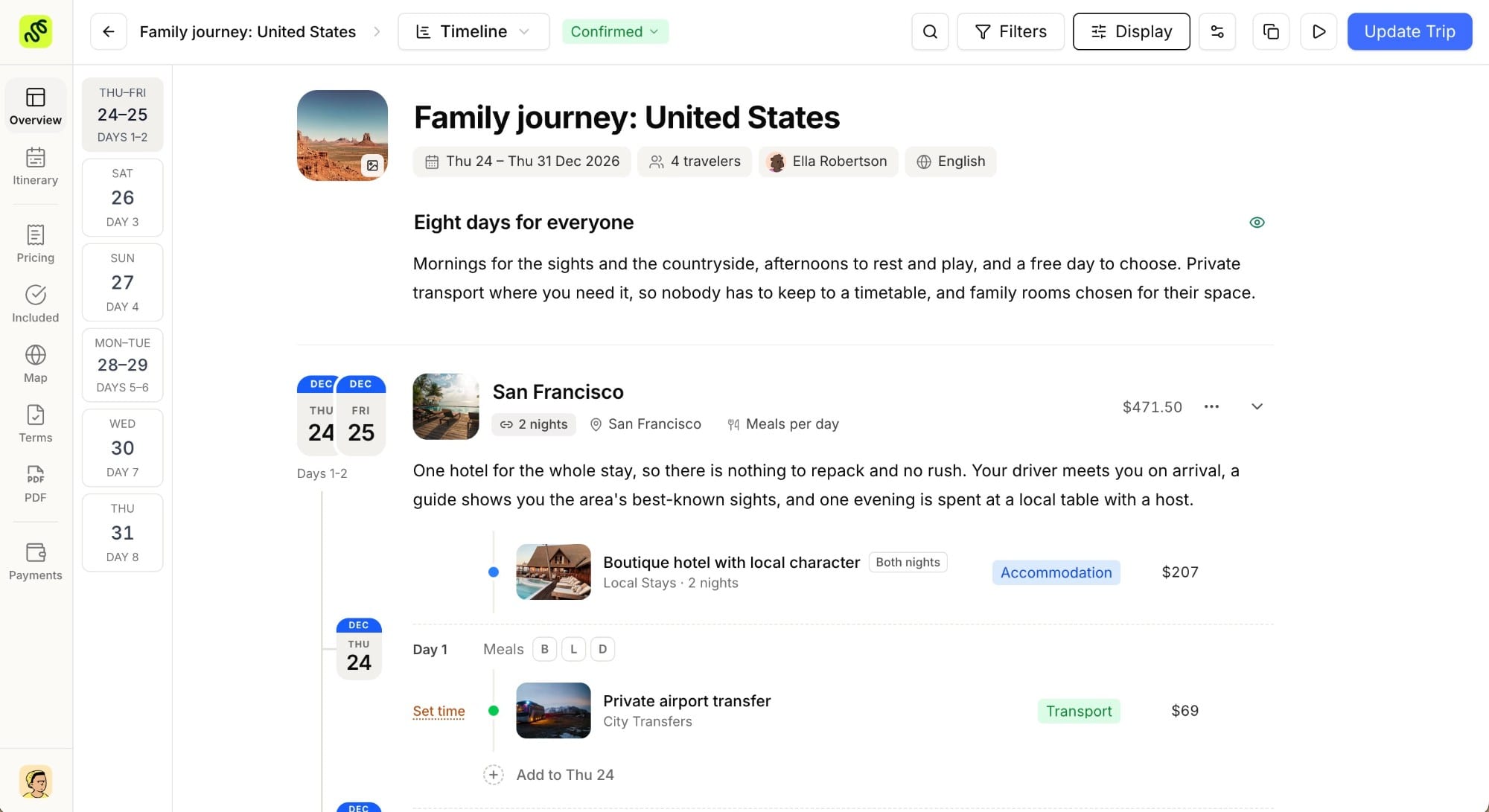
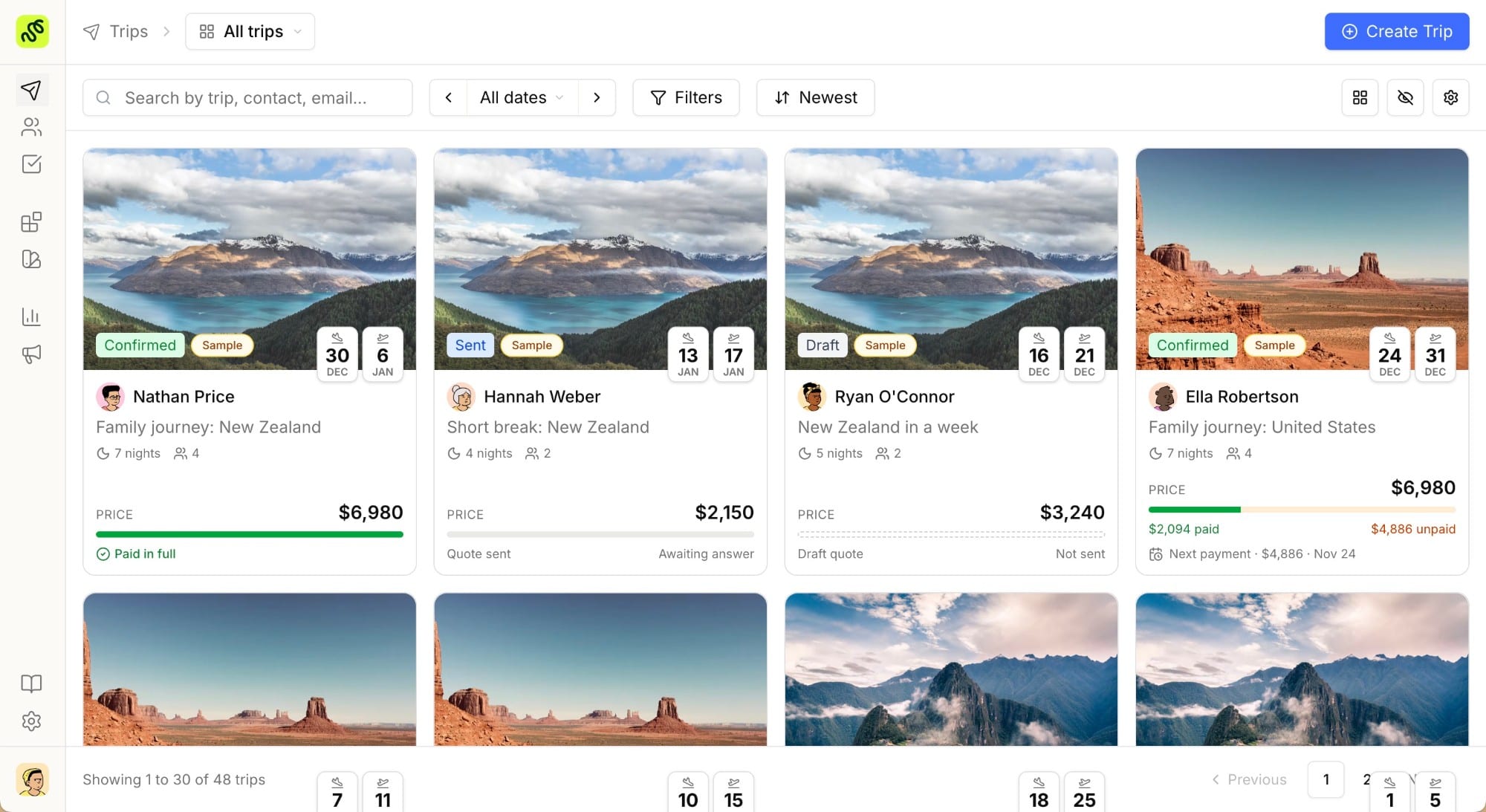
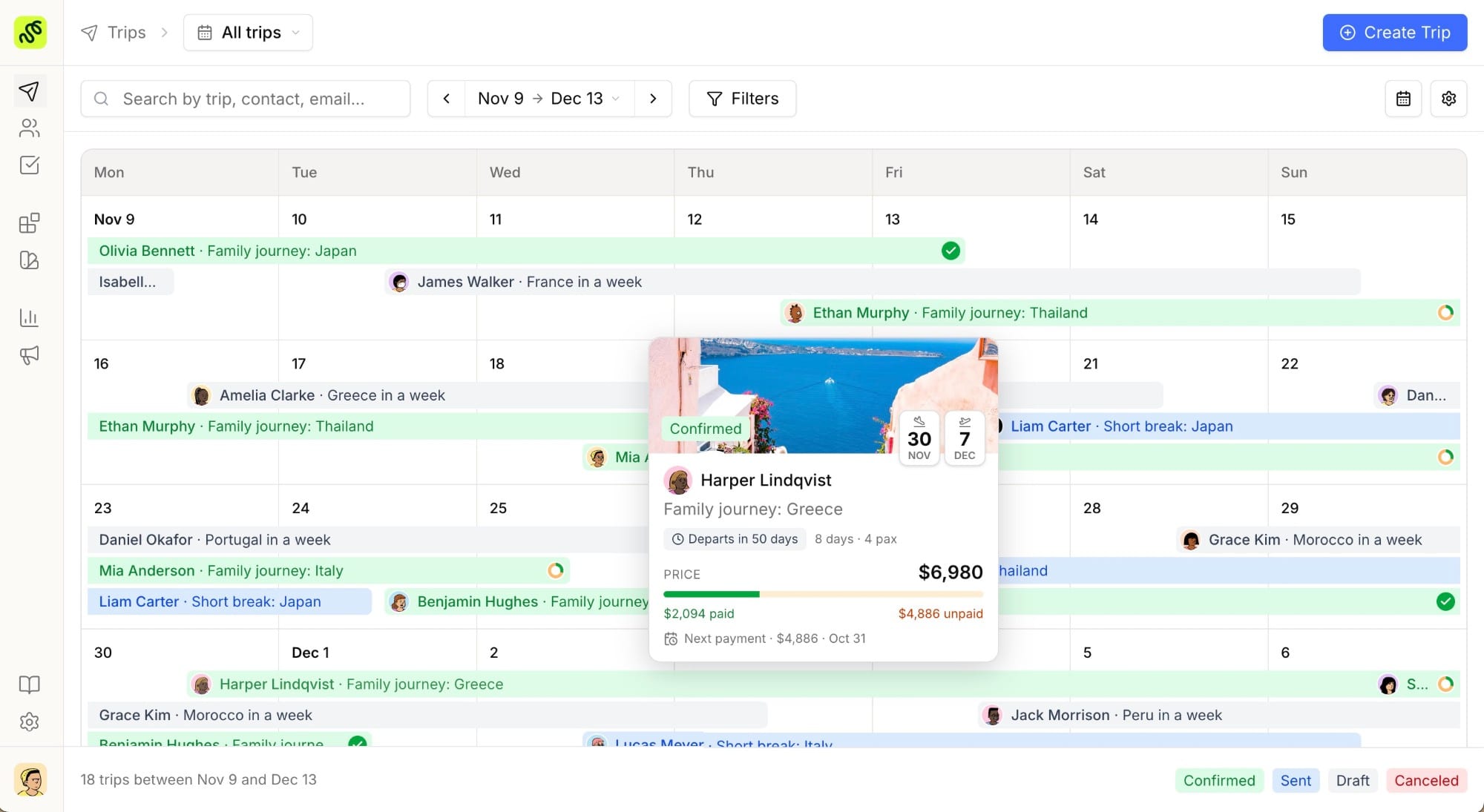
If your travel agency already runs on software (a CRM in one tab, an itinerary tool in another, a separate payment link, and a spreadsheet for reporting), the question is no longer whether to adopt software. It’s whether to keep stitching point solutions together or move to all-in-one travel agency software that holds itinerary building, client management, and analytics in one place. This guide compares the two approaches honestly: where a best-of-breed stack still wins, where a unified platform pulls ahead, and how to tell which one fits the way your agency actually works.
What all-in-one travel agency software actually means
The term gets used loosely, so it’s worth being precise. All-in-one travel agency software is a single platform, on a single subscription and a single shared database, that covers the core of how an agency operates:
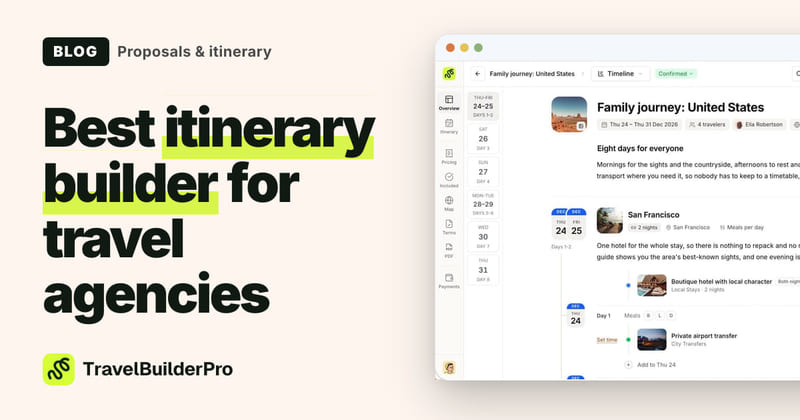
- Itinerary building: an itinerary builder that turns repeatable day blocks, supplier cards, and pricing into a branded, shareable proposal.
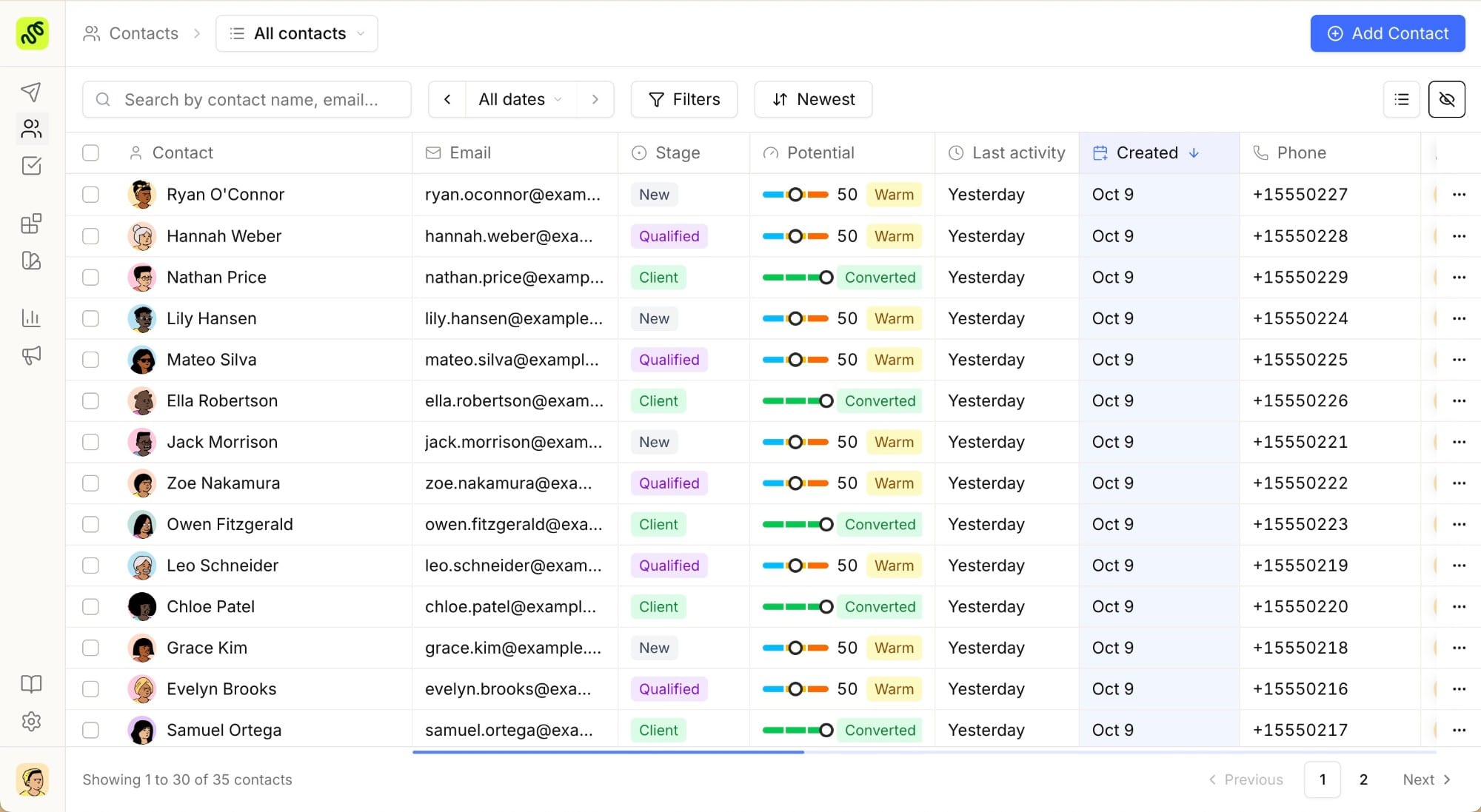
- Client and lead management: a travel CRM that tracks every contact, where they sit in the pipeline, and every proposal or conversation tied to them.
- Visibility: built-in analytics that report conversion and revenue by source without a manual export.
The defining trait isn’t the feature list: most standalone tools do one of these things well. It’s that all three share the same records. A lead becomes a contact, a contact gets a proposal, a proposal becomes a booking, and the whole path stays visible without re-keying data between systems.
A point-solution stack, by contrast, assembles the same capability from separate best-of-breed products: a dedicated CRM, a separate itinerary designer, a standalone payment processor, and a reporting layer bolted on top. Each piece may be excellent on its own. The cost lives in the gaps between them.
The hidden cost of a point-solution stack
Running four specialized tools instead of one platform carries expenses that never appear on a single invoice:
- Double data entry. A client’s name, trip dates, and budget get typed into the CRM, then again into the itinerary tool, then again into the payment system. Every re-entry is a chance to introduce a stale figure.
- The integration tax. Connecting tools through Zapier, native syncs, or CSV exports takes setup time and ongoing maintenance. When one vendor changes an API, the chain breaks quietly, and usually at the worst moment.
- Context switching. Answering “where does this booking stand?” means checking three places: the CRM for the conversation, the itinerary tool for the proposal, and the payment app for the deposit.
- No single source of truth. When reporting lives in a different system than bookings, the numbers drift. Reconciling them by hand is the kind of Friday-afternoon task that quietly eats a day a month.
- Stacked per-seat pricing. Four subscriptions, each billed per user, often costs more than one platform priced for the whole workflow: before you count the hours spent gluing them together.
None of this means point solutions are bad tools. It means the seams between them are where small agencies lose time.
Comparison table: all-in-one platform vs separate tools
| Dimension | Separate best-of-breed tools | All-in-one travel agency software |
|---|---|---|
| Data model | One record per tool, kept in sync manually or via integrations | One shared record across itinerary, CRM, and analytics |
| Lead-to-booking flow | Re-entered at each stage across systems | Continuous: a lead carries through to a booking |
| Reporting | Exported and merged from multiple sources | Live dashboard, updated automatically |
| Pricing | Several per-seat subscriptions to add up | One subscription for the core workflow |
| Onboarding a new hire | Learn four interfaces and how they connect | Learn one workspace |
| Maintenance | Integrations to configure and monitor | Nothing to wire together |
| Multi-currency / multi-language | Depends on each tool; often partial | Built in across proposals |
| Best fit | Agencies with a deep, specialized need in one area | Independent designers and small-to-mid agencies |
When separate tools are the right call
A unified platform isn’t automatically the better choice. A best-of-breed stack genuinely wins in a few situations:
- You have one deep, specialized requirement that a general platform can’t match: for example, complex supplier-side accounting, or a reservation engine tuned to a specific inventory model.
- You’ve already invested heavily in a tool your team knows well, and the switching cost outweighs the friction of keeping it.
- Your workflow is unusual enough that no single platform covers it, so you’d end up bolting on extra tools anyway.
Some legacy platforms in this space (Tourwriter, for instance) are built for large, established tour operators with enterprise budgets and deep accounting integrations. If that’s your world, a specialized setup can be worth the complexity. The all-in-one question matters most for agencies below that scale.
When an all-in-one platform wins
For an independent travel designer or a small-to-mid-size agency, the balance usually tips the other way:
- You send proposals regularly and want the lead, the itinerary, and the booking to live in one place instead of three.
- You’re a small team where “ask whoever built it” doesn’t scale, and structured records anyone can read matter more than best-in-class depth in any single tool.
- You’d rather not maintain integrations. Time spent keeping tools talking to each other is time not spent designing trips or following up with clients.
- You want clear reporting without exporting and merging spreadsheets to see which trip types and lead sources actually convert.
At this size, the consolidation itself is the feature. The gain isn’t a longer feature list: it’s the hours a fragmented stack quietly costs.
How to evaluate all-in-one travel agency software
If you decide to consolidate, not every all-in-one option is built the same way. A short checklist keeps the comparison grounded:
- A trial that unlocks every feature, so you can test the full workflow with real clients before committing budget, not a stripped-down demo.
- Transparent, published pricing rather than a “contact sales” form, so you can compare the total against your current stack of subscriptions.
- Itinerary, CRM, and analytics in one subscription, not three modules that are separately licensed and only loosely connected.
- Straightforward migration. CSV import for contacts and help rebuilding a template or two should fit inside a trial, not a multi-week project.
- A fast setup. If onboarding is measured in weeks, that’s a cost too, and a sign the platform is aimed at a larger operation than yours.
If you want to see how one platform prices the whole workflow against a stack of separate tools, the pricing page lays it out in full.
Try every feature free for 7 days
TravelBuilderPro combines an itinerary builder, CRM, and analytics in one workspace, with a 7-day full-feature trial on signup. See what your whole client workflow looks like in one place before you decide.
Common questions
01What is all-in-one travel agency software?
It’s a single platform that combines the core tools an agency uses (an itinerary builder, a client and lead CRM, and booking analytics) on one subscription and one shared database. The point is that the tools share data, so a lead flows through to a booking without being re-entered between systems.
02Is all-in-one better than best-of-breed separate tools?
It depends on scale and need. Best-of-breed stacks win when you have one deep, specialized requirement that a general platform can’t match. All-in-one platforms win for independent designers and small-to-mid agencies, where the time lost gluing tools together outweighs any single tool’s extra depth.
03Will I lose functionality moving from separate tools to one platform?
Sometimes a standalone tool has more depth in its niche, so check that the platform covers your must-haves before switching. For most small agencies, though, the features they actually use daily (proposals, pipeline, reporting) are all present, and having them connected outweighs the depth they rarely touched.
04How hard is it to migrate from multiple tools to an all-in-one platform?
Usually easier than expected. Active contacts import from CSV, and one or two itinerary templates are rebuilt during setup. Most of what feels risky to move (old, inactive leads) doesn’t need migrating at all, and a full-feature trial is enough to test the workflow against a real client proposal first.
Summarize this article with AI
Opens your assistant with the question already written.