A group travel itinerary is a fixed, pre-designed trip sold to many travelers at a set per-person price on set departure dates, and it is built to a completely different brief than a one-off custom trip. You design it once, cost it once, and then sell the same document dozens of times, so the hours you invest up front are spread across every seat you fill. I spent ten years running group departures before I built software for agencies, and the mistake I see most often is a designer applying bespoke habits to a group product, where they quietly destroy the margin. Here is how to build a group travel itinerary that is profitable to sell and painless to repeat.
How a group itinerary differs from a custom one
A Group Inclusive Tour (GIT) is the opposite of a bespoke trip in almost every way that matters to how you build it. A FIT itinerary is finished once and sold exactly once, so every hour of design has to be justified by a single booking. A group itinerary is finished once and sold many times, so the economics reward effort spent on reusability, accurate costing, and a departure that fills.
That single difference changes your priorities. On a custom trip, personalization is the product. On a group departure, consistency is the product: the same coach, the same guide, the same hotels, the same schedule, running to a plan that has already been stress-tested by the groups before this one. Your job is not to make each traveler feel the trip was built for them alone. It is to design a strong shared experience that a wide enough slice of your audience will happily pay a fixed price to join.
Get that framing right and the rest follows. Get it wrong, and you end up offering custom-trip flexibility on a group-trip price, which is the fastest way I know to lose money on a full coach.
Fix the departure before you design the days
With a custom trip you start from the traveler. With a group travel itinerary you start from the departure, because the commercial decisions you make here constrain everything in the schedule.
- Set the dates and the season first. Group product lives or dies on departure dates. Pick dates where your suppliers have availability at group rates, where the weather supports the experience you are selling, and where you can realistically fill the seats before your deposit deadlines.
- Decide the group size band. A minimum and maximum, not a single number. The minimum is your break-even point: the number of paying travelers below which the departure does not run. The maximum is set by your coach, your guide, and the hotels’ ability to hold a block of rooms. I rarely built a tour that worked below fifteen paying travelers or above a single coach’s worth.
- Lock the free-place model. Most group pricing assumes a free-of-charge place for every so many paying travelers, often framed as a “15+1” or “20+1,” which covers a tour leader or rewards the agent who fills the group. Decide this before you cost anything, because it changes your per-person price directly.
Only once the departure is fixed does it make sense to design the actual days. A beautiful itinerary on dates your suppliers cannot service at group rates is not a product. It is a quote you cannot honor.
Design the days for a group, not an individual
Group pacing is its own craft. A party of two can decide over breakfast to skip the morning and sleep in. Forty travelers on a coach cannot, so the schedule has to carry the group smoothly without feeling like a forced march.
A few rules I learned the slow way:
- Anchor each day around one shared highlight, then leave genuine free time around it. Groups tolerate a packed schedule far less than individuals do, and the complaints that sink your reviews are almost always about pace, not about the hotels.
- Build the logistics around the slowest realistic case. Loading and unloading a full coach, a group lunch that takes ninety minutes rather than sixty, a bottleneck at a single ticket desk. Buffer time that looks generous on paper is what keeps the day from unraveling by mid-afternoon.
- Standardize the rooming. Group rates are quoted on twin-share rooms, so your base price assumes two travelers per room and you add a single supplement for solo travelers. Decide how many singles you can hold before you publish, because hotels cap them inside a group block.
- Name the handoffs. The guide meeting the coach, the local partner running an included activity, the restaurant holding the group booking. Write them into the itinerary so everyone knows who owns what, and when.
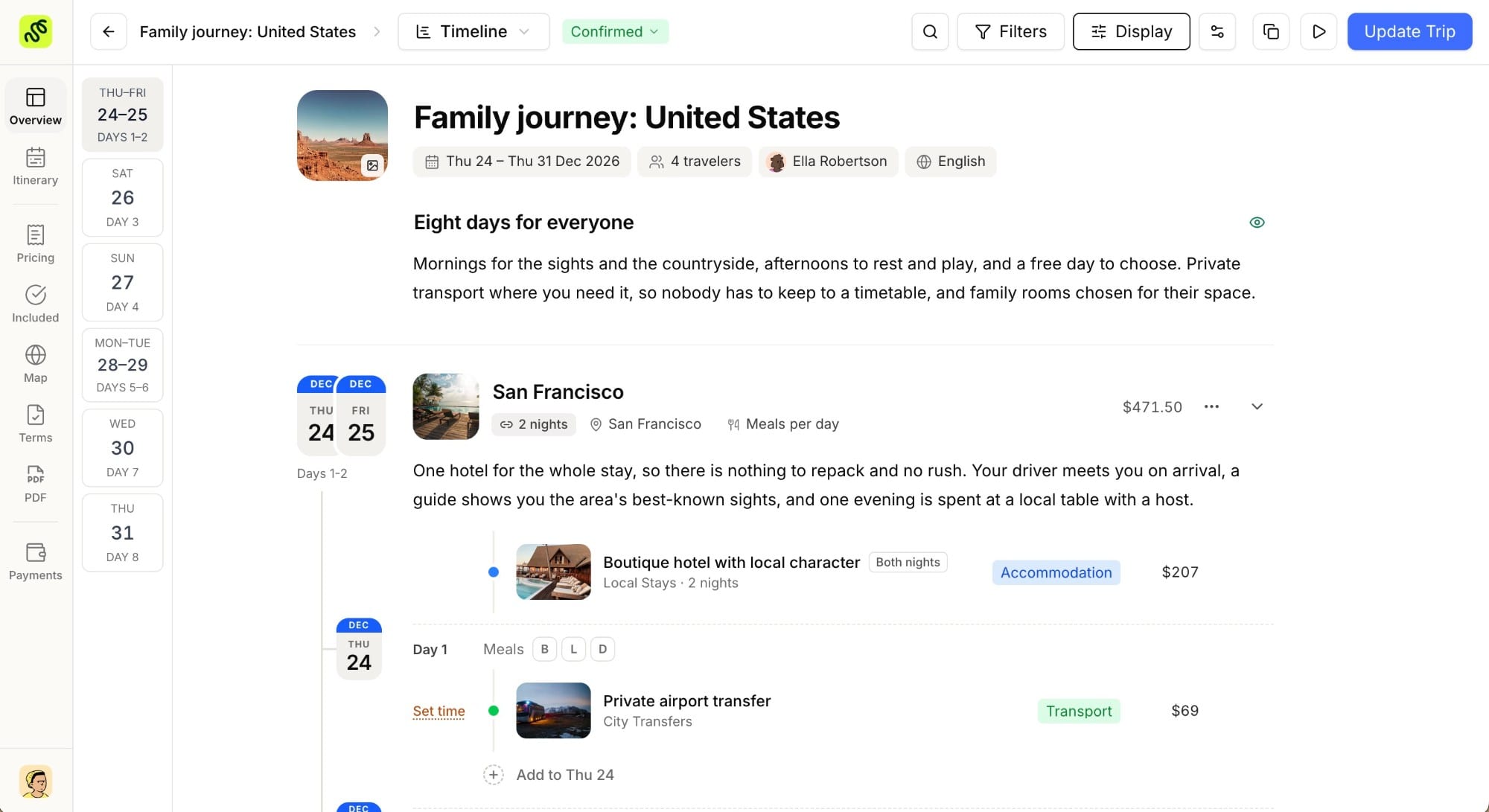
This is also where a live itinerary builder earns its place. Designing the departure in the same tool your travelers will eventually see keeps the day-by-day structure, the inclusions, and the logistics in one place, instead of scattered across a spreadsheet, a slide deck, and a rooming list that nobody can find the morning the coach leaves.
Price the group travel itinerary properly
Per-person group pricing is where good itineraries lose money, because the maths is genuinely different from a custom quote. You are not marking up one trip. You are dividing fixed costs across a variable number of travelers and hoping the departure fills past break-even.
Work it in this order:
- Separate fixed costs from per-person costs. The coach, the guide, and any included group activity with a flat fee are fixed: they cost the same whether twenty or forty travelers board. Hotels, meals, and per-head entrance fees scale with the group. Your per-person price has to absorb a share of the fixed costs, and that share shrinks as the group grows.
- Price at your realistic group size, not your maximum. If you cost the tour assuming a full coach and it runs two-thirds full, the fixed costs you spread too thin come straight out of your margin. I always costed to a conservative, sellable number and treated a fuller departure as upside.
- Fold in the free places. Every free-of-charge seat is a cost the paying travelers cover, so build it into the per-person figure from the start rather than discovering it at reconciliation.
- Add your markup on top of the net cost. Group product carries a lower markup per seat than bespoke work, and it earns through volume instead. If you are not clear on the difference between the net rate your suppliers give you and the gross price your travelers pay, your group pricing will be guesswork.
The reason groups are worth the trouble is this volume: a departure that fills turns one design effort into many bookings. That only works if the break-even number is honest and the price holds up once the free places and the single supplements are in it.
Make the itinerary reusable
The whole economic case for group product is reuse, so build the itinerary as an asset you will run again, not as a one-time document.
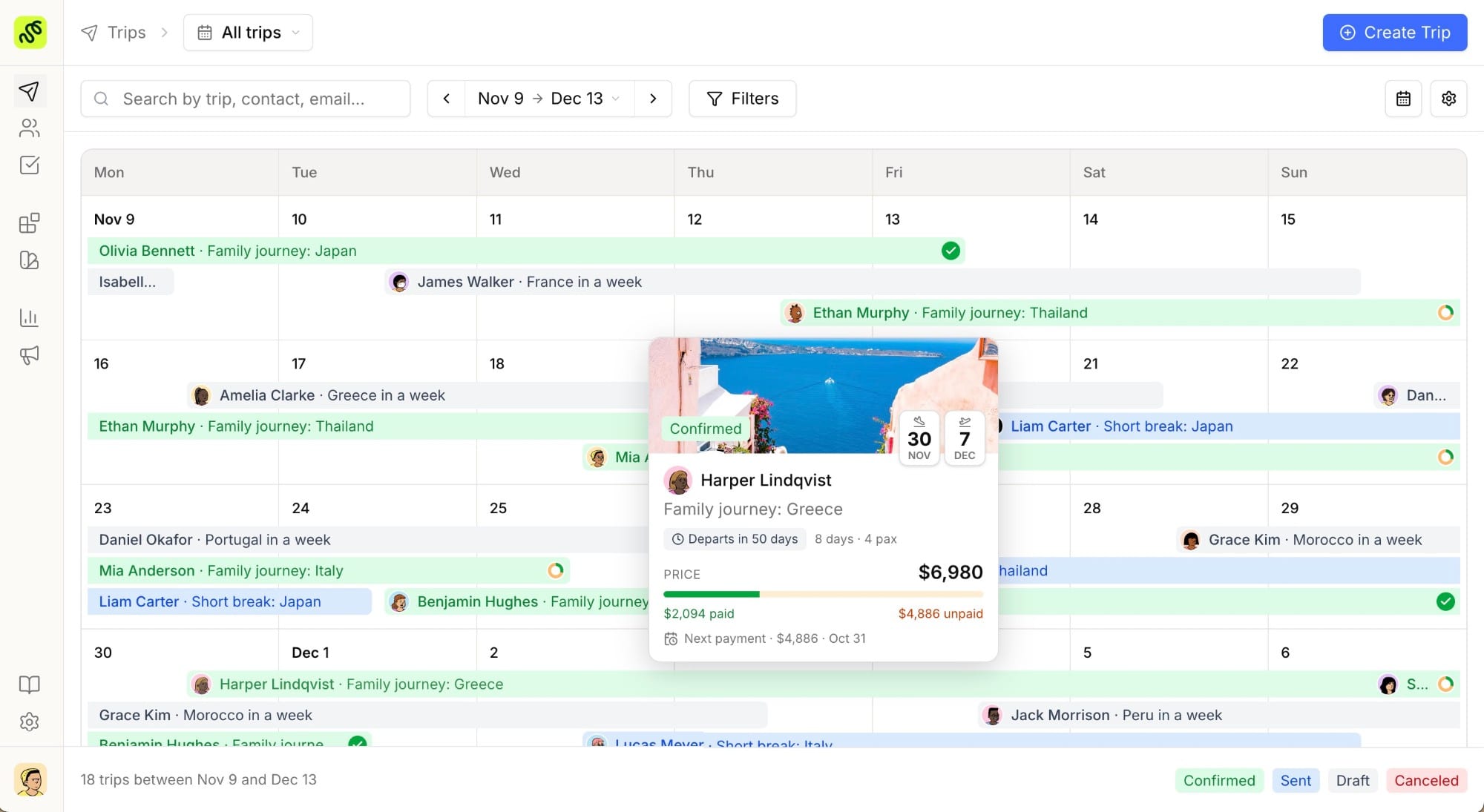
- Template the structure, swap the dates. A departure that worked in spring will usually work again in autumn with new dates and refreshed pricing. If your itinerary is trapped in a one-off PDF, you rebuild it from scratch every season. If it lives as a reusable template, you clone it, update the departure, and republish in an afternoon.
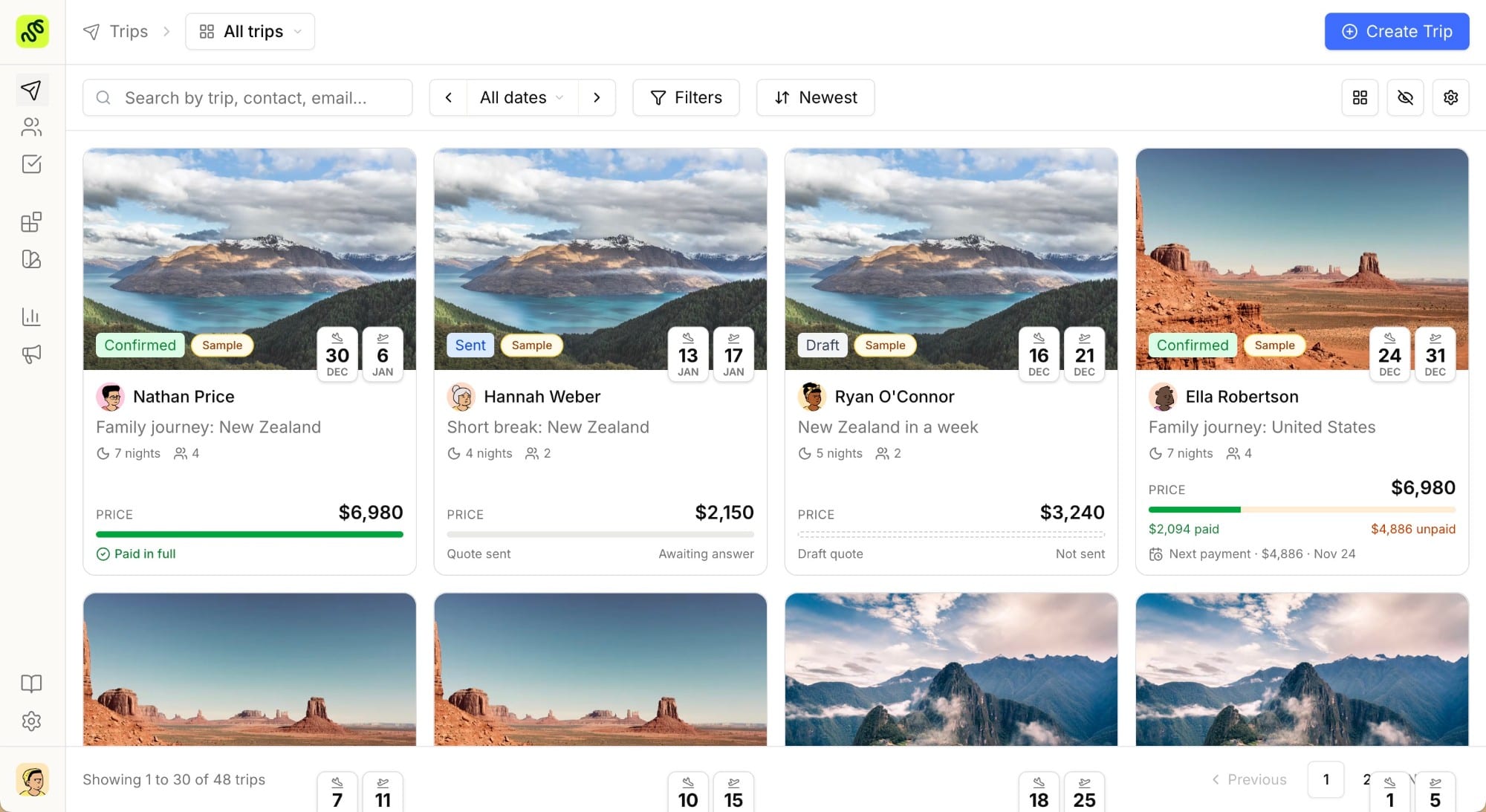
- Keep your group inventory in one place. The room allotments you hold, the coach, the guide’s availability: these are the constraints that decide whether a repeat departure is even possible, and they belong somewhere you can actually see them. Managing suppliers and group blocks in your operations workspace, rather than in a chain of emails, is what makes the second and third run of a tour fast.
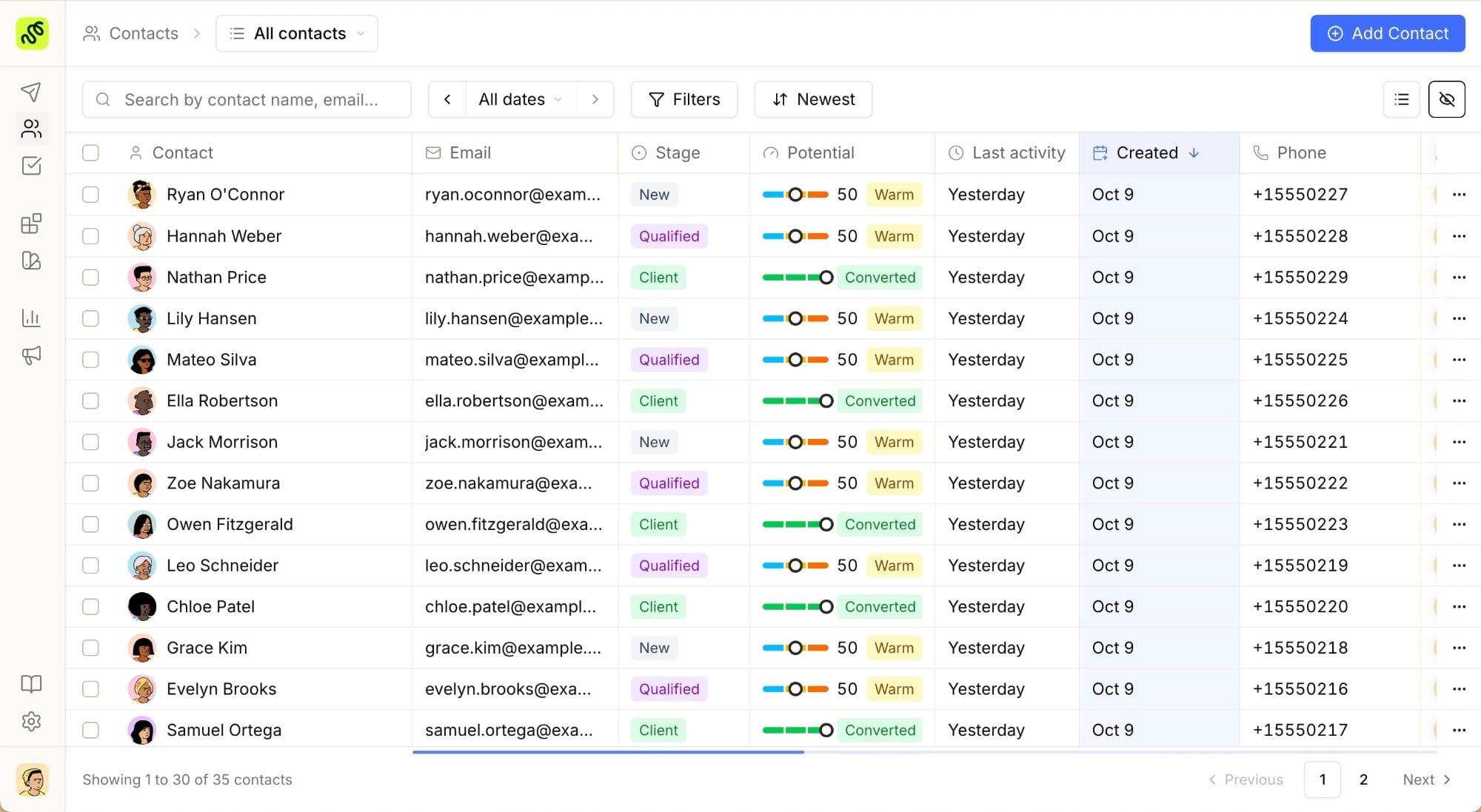
- Carry the participant data forward. Travelers who enjoyed one departure are your warmest lead for the next one. Keeping them in your CRM, segmented by the trip they took, turns a one-time group into a repeat audience you can sell the next season’s departure to directly.
A group travel itinerary you can only run once is a FIT trip wearing a group’s clothing, and it carries all the cost of group logistics with none of the volume payoff.
Common group travel itinerary mistakes
The patterns that sink group departures are consistent, and almost all of them trace back to treating the trip like a custom one:
- Pricing to a full coach. Optimism in the costing sheet becomes a loss on the invoice the moment the departure runs light.
- Over-packing the schedule. A day that works for a couple exhausts a group, and pace complaints do more damage to a repeatable product than any single hotel choice.
- Forgetting the single supplement until someone asks. Solo travelers join groups constantly, and a base price with no single plan forces an awkward re-quote right when you want to be closing the sale.
- Allowing custom-trip changes. The traveler who wants a different hotel or an extra night is asking for a FIT trip. Say yes to that as a separate, higher-priced product, not as a free change to a fixed departure.
- Building it so it cannot be run again. If every season starts from a blank page, you never capture the reuse that makes group product worth doing at all.
Group departures reward discipline. The agencies that do well with them treat the itinerary as a product with a fixed shape and a known break-even, and they save the flexibility for the custom work where travelers pay for it. If you also run corporate or incentive groups, the same build-once logic applies to MICE programs, with even tighter logistics.
Try every feature free for 7 days
Build a group departure once, then clone it, re-date it, and sell it season after season in one workspace. Start free: full access for 7 days, cancel any time before it ends.
Common questions
01What is a group travel itinerary?
A group travel itinerary is a fixed, pre-designed trip sold to many travelers at a set per-person price on specific departure dates. Unlike a custom trip built for one party, it is designed once and sold repeatedly, with group pricing, twin-share rooming, and a schedule built to move a whole group smoothly.
02How is a group itinerary priced differently from a custom trip?
Group pricing divides fixed costs, such as the coach and the guide, across a variable number of travelers, then adds hotels and meals that scale per head, plus any free places and a single supplement for solo travelers. The per-person price should be costed to a realistic, sellable group size rather than a full departure, because thin departures erode margin fastest.
03What group size should a departure be built for?
Set a minimum and a maximum. The minimum is your break-even: the number of paying travelers below which the trip does not run. The maximum is capped by your coach, guide, and the room block your hotels will hold. Costing to a conservative number and treating a fuller coach as upside protects your margin.
04Can the same itinerary be reused for future departures?
Yes, and that reuse is the entire commercial case for group product. Template the structure, swap in new dates, refresh the pricing, and carry past participants forward as warm leads for the next season. An itinerary trapped in a one-off document throws that advantage away.
Summarize this article with AI
Opens your assistant with the question already written.