If you run a travel agency, a tour operation, or a DMC on Moonstride and the platform feels heavier (or pricier) than your team needs, you are not alone in looking for a Moonstride alternative. Moonstride is a capable travel CRM, back office, and booking engine, but it is sold through demos and bundled user tiers, which does not suit every independent designer or small team. This guide compares Moonstride with TravelBuilderPro, an itinerary builder, CRM, and analytics tool with transparent pricing and a self-serve trial, so you can decide which one fits the way you actually work.
What Moonstride does well
Moonstride is a Greater London travel-tech company, and its strength is breadth: it tries to run the whole business in one system rather than just the client-facing part of it.
An all-in-one back office
The platform covers enquiries, quotations, bookings, group management, supplier and contract records, and a sales and purchase ledger. For an operator who wants finance and operations in the same place as the sales desk, that depth is genuinely useful. It is closer to a classic tour-operator suite than to a lightweight proposal tool.
A B2C and B2B booking engine
Moonstride includes an online booking engine for both direct travelers and trade partners, plus integrations with travel-service APIs and payment providers. If you sell fixed inventory or series departures online, that distribution layer is a real advantage.
Who it fits best
Moonstride aims at travel businesses that want deep back-office and distribution features in one platform, from small agencies up to larger tour operators and OTAs. The more of that machinery you will actually use, the better the fit.
Where agencies look for a Moonstride alternative
Breadth has a cost, and that cost is where most searches for a Moonstride alternative begin.
Pricing is quote-led and bundled
Moonstride does not publish pricing on its own site. Third-party directories (TrustRadius, late 2026) list monthly tiers bundled around three users, roughly $99–$325 depending on the module set, with enterprise quoted on request. Treat those figures as indicative and confirm current pricing with the vendor. For a solo designer or a two-person team, paying for three-user bundles can mean paying for seats you will not fill.
There is no self-serve free trial
Moonstride is sold demo-first: you book a call before you can get into the product. Teams that want to sign up and test the tool on a live trip the same afternoon tend to look for something they can try without a sales conversation.
The platform can be more than a small team needs
A full ledger, contract management, and a booking engine are powerful for a high-volume operator. A boutique agency that mostly designs bespoke, tailor-made trips may use a fraction of that surface while still carrying its complexity in daily work. The question to ask is not whether a feature exists, it is whether your team will touch it in a normal week. Modules you never open still add screens to learn, settings to maintain, and seats to pay for.
Moonstride vs TravelBuilderPro at a glance
The table states facts on both sides, including the ones that do not favour us. Competitor figures come from the vendor’s public materials and third-party directories (verified late 2026); confirm them before you decide.
| Feature | Moonstride | TravelBuilderPro |
|---|---|---|
| Target user | Small-to-large agencies, tour operators, OTAs, DMCs | Independent designers, small-to-mid agencies and DMCs |
| Free plan | No free plan | 7-day free trial |
| Free trial | Demo-led, no self-serve free trial published | 7 days, every feature, cancel anytime |
| Pricing | Not published publicly; third-party listings show tiers around $99–$325/month (3-user bundles), enterprise custom | Starter from €22/user/month yearly, Professional €39, Premium €62 |
| Itinerary builder | Yes | Yesdrag-and-drop day-by-day layout |
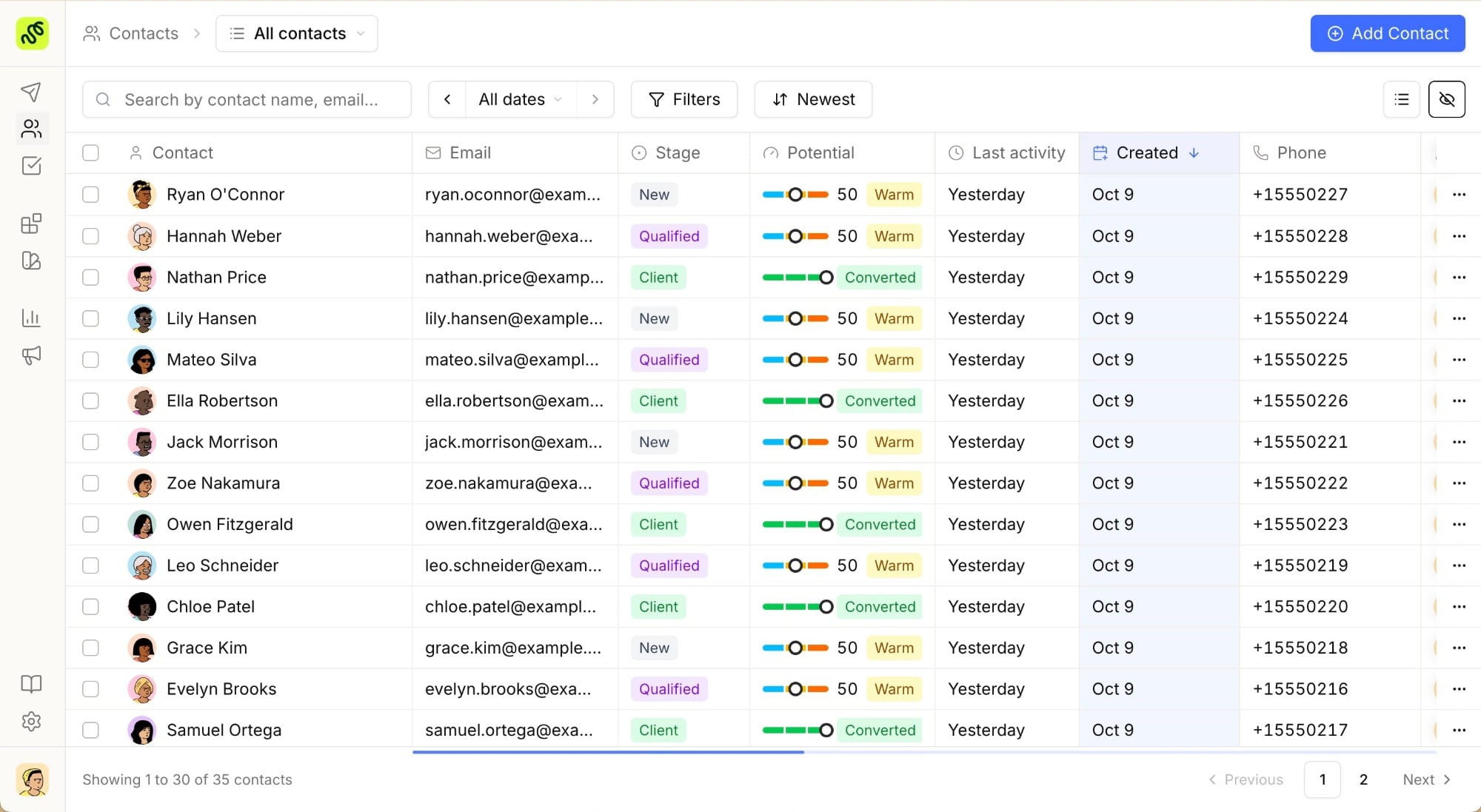
| Built-in CRM | Yesenquiries, quotes, bookings | Yescontacts, leads, pipeline, web forms, tasks |
| Booking engine / distribution | YesB2C and B2B booking engine | Proposal-to-booking flow, no public booking engine |
| Back-office finance | Sales and purchase ledger | Supplier rates and payments, accounting via Zapier / Make / API |
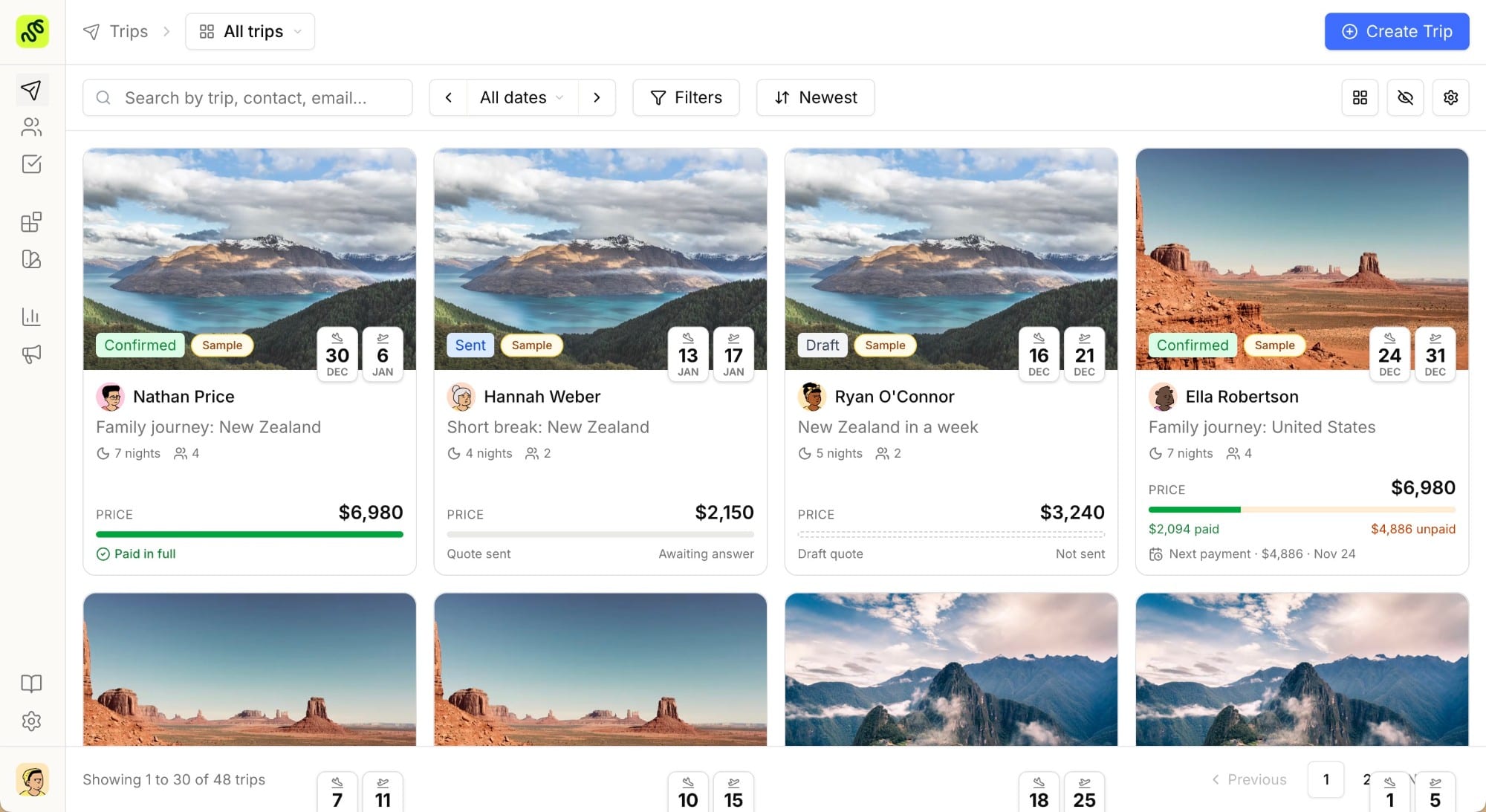
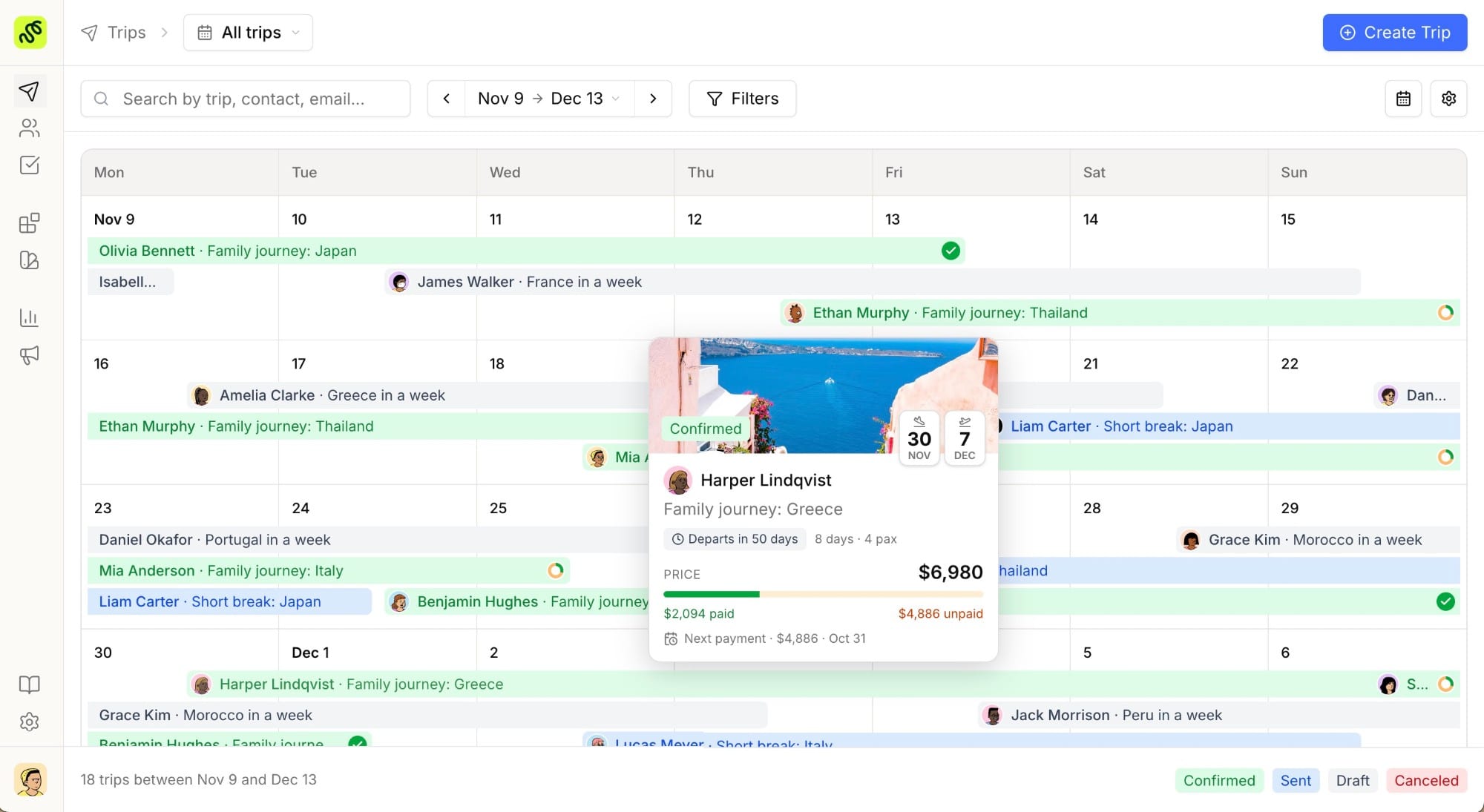
| Analytics | Reporting and BI | Real-time dashboard with conversion and revenue KPIs |
| Company base | Greater London, UK | EU (hosting in the EU, SOC 2 compliant) |
Read down the table and the pattern is clear. Moonstride wins on operational depth: a booking engine, a ledger, and distribution that a volume operator needs. TravelBuilderPro wins on the parts most independent agencies spend their day in: designing the trip, managing the client, and reading the numbers, bought on public per-user pricing you can start without a sales call. Neither is better in the abstract. The right pick is the one whose strengths match where your week actually goes.
When each tool wins
When Moonstride is the better choice
Pick Moonstride if you run a high-volume tour operation or OTA that needs a B2C and B2B booking engine, ledger-grade finance, and deep distribution in one system, and you have a team large enough that three-user bundles are not wasted. If your needs sit at the classic tour-operator-suite end of the market, our Tourwriter comparison covers that segment too.
When TravelBuilderPro is the better fit
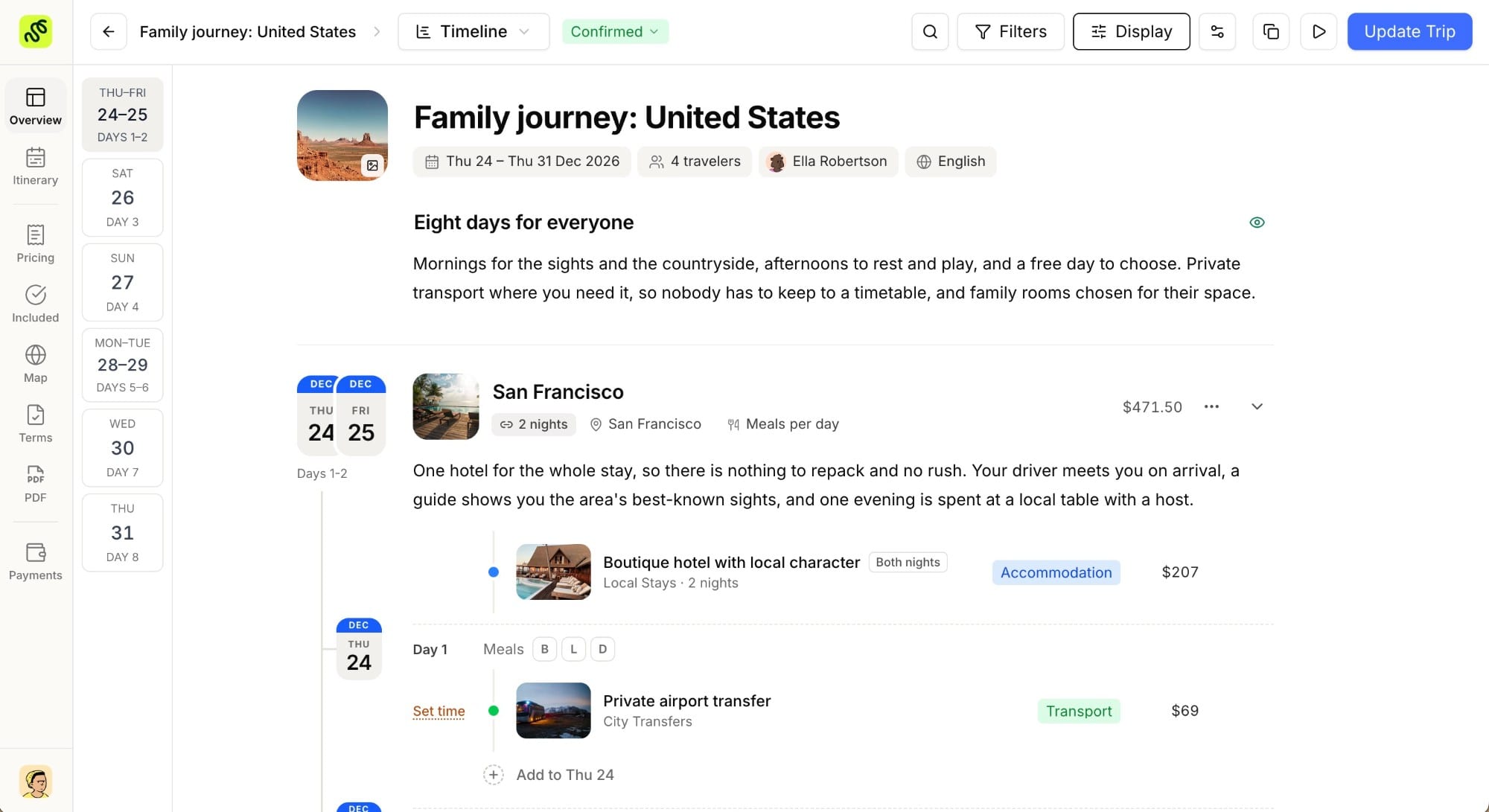
Pick TravelBuilderPro if you are an independent designer or a small-to-mid agency moving away from a heavy system or from spreadsheets. You get a modern itinerary builder, a built-in CRM with contacts, pipeline, and web forms, and a real-time analytics dashboard in one workspace, so you are not paying for a booking engine you do not run. Suppliers, rates, and payments live together in operations, and proposals export in 66 languages for international clients.
A note on pricing you can see
TravelBuilderPro publishes its full pricing openly: Starter from €22 per user per month on the yearly plan, Professional at €39, and Premium at €62. You can read the plans, start a 7-day full-feature trial on signup, and only convert to the plan you chose if you do not cancel. There is no quote and no demo gate before you try it.
Moving from Moonstride without losing data
Switching platforms sounds risky, but most of the work is a clean export and a short rebuild.
Export contacts, quotes, and bookings
Export your contacts and booking history from Moonstride as CSV. TravelBuilderPro supports CSV import on day one, so your client base and quote history come across without manual re-entry.
Rebuild templates during the trial
Use the trial window to rebuild your most-used itinerary templates in the new builder. The team helps during onboarding, and supplier records can be added manually or through the API. Most small agencies are running real proposals inside the first week.
Before you commit, list the three or four Moonstride modules you open every day and confirm each has a home in the new tool: proposals in the itinerary builder, contacts and follow-ups in the CRM, rates in operations, and numbers in analytics. If a booking engine or a formal ledger is on that list, keep it in mind as a point in Moonstride’s favour. If it is not, the move is lighter than it looks, and you lose none of the work that matters.
Try it on your own trips
The fastest way to judge a Moonstride alternative is on your own trips, not in a demo. Build a real proposal, add your suppliers, and watch the analytics update as you go. Try every feature free for 7 days and see whether an itinerary builder, a CRM, and analytics in one workspace is enough for the way your agency sells.
Common questions
01Is TravelBuilderPro a good Moonstride alternative?
Yes, for independent designers and small-to-mid agencies and DMCs. It combines an itinerary builder, a CRM, and booking analytics with transparent per-user pricing and a 7-day full-feature trial, which is the gap most teams feel when they outgrow spreadsheets but find a full back-office suite like Moonstride larger than they need.
02Does Moonstride have a free trial?
Moonstride is sold demo-first, and third-party directories list it with no self-serve free trial or free version. You book a demo to see the product. Confirm the current trial policy with the vendor, since this can change. TravelBuilderPro, by contrast, offers a 7-day trial of every feature on signup, with no sales call required.
03How much does Moonstride cost?
Moonstride does not publish pricing on its own site. Third-party listings (late 2026) show monthly tiers bundled around three users, roughly $99 to $325 depending on modules, with enterprise quoted on request. Verify these figures directly with Moonstride before you budget.
04Can I move my data from Moonstride to TravelBuilderPro?
Yes. Contacts and booking history export from Moonstride as CSV and import into TravelBuilderPro on day one. Itinerary templates are rebuilt during onboarding, and supplier records can be imported via the API or added manually.
Summarize this article with AI
Opens your assistant with the question already written.