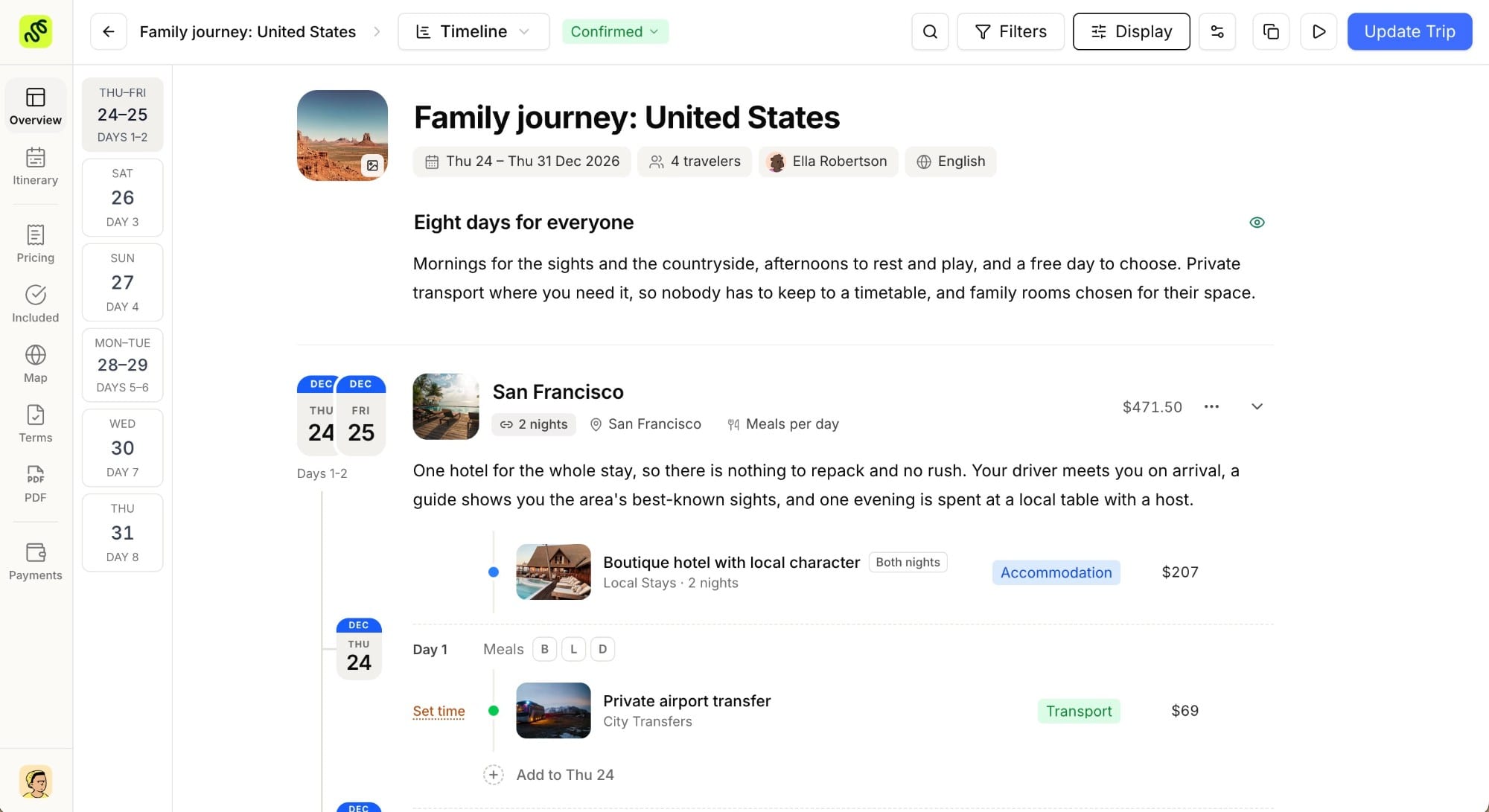
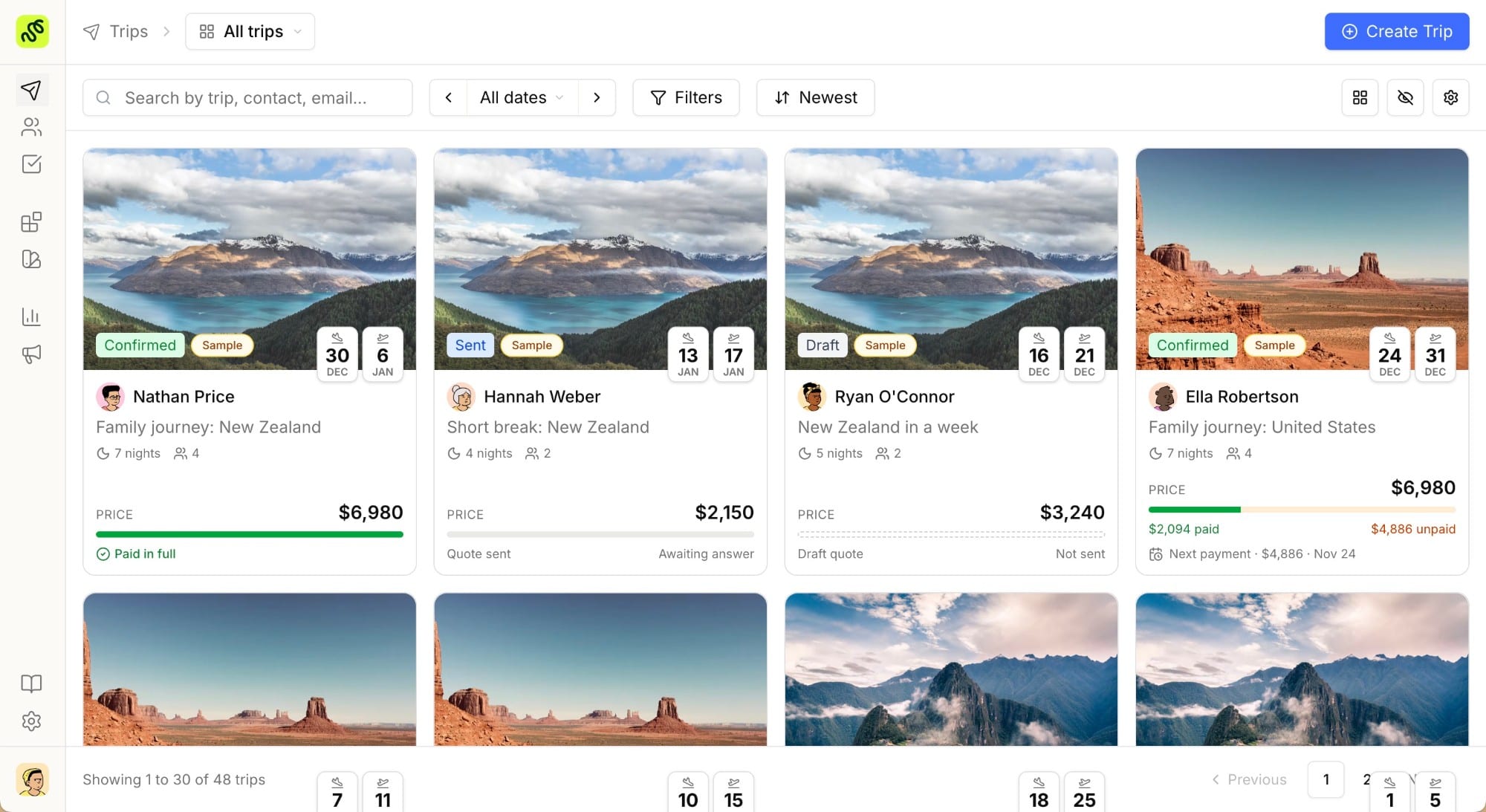
If you are weighing a Tern alternative, you are probably a travel advisor or small agency who likes the idea of one platform for itineraries, client management, and commissions, but wants to be sure it fits how you actually sell before you commit a seat budget. Tern is a modern, advisor-first tool with strong host-agency and commission workflows. TravelBuilderPro covers a lot of the same ground (itinerary building, a built-in CRM, and booking analytics), but starts at €22 per user per month and serves independent designers and agencies worldwide, not only the US host-agency ecosystem. This guide compares the two so you can pick on facts, not marketing.
What Tern does well
Tern is an all-in-one workspace built for travel advisors and agencies. It replaces a stack of separate tools (a CRM, an itinerary builder, intake forms, a scheduler, and back-office reporting) with one dashboard. Its standout strengths, as of 2026, are:
- Commission workflows. Tern calculates commission splits automatically when a booking is created, reconciles supplier payments, and generates payout statements. For agencies working under a host, or hosts managing sub-agencies and advisor splits, this is genuinely useful.
- Host-agency and consortia fit. Tern is built around the US advisor world and works with consortia and host networks such as Virtuoso, Signature, and Travel Leaders Network.
- AI assistance. Built-in AI tools (an assistant and a meeting notetaker) help with the busywork of planning and client notes.
- Drag-and-drop itineraries with reusable templates, automatic pricing, and custom intake forms that spin up a trip automatically.
If your business runs on host-agency commission reconciliation and you are firmly inside the US consortia ecosystem, Tern is a strong, purpose-built choice.
Why look for a Tern alternative?
Most advisors who shop for a Tern alternative are not unhappy with the concept. They are checking fit on a few specific points:
- A higher entry price. Tern offers a free trial to explore the full feature set, but its published plans start at $35 per user per month (Tern pricing, 2026): against €22 for TravelBuilderPro’s Starter tier billed yearly. On a two- or three-seat agency that gap compounds every month.
- Built around the US host-agency model. The commission-split and consortia workflows are a strength if you live in that world, and largely irrelevant if you are an independent travel designer, a DMC, or an agency outside North America.
- You want proposal conversion analytics, not just commission reporting. Commission tracking tells you what you earned. It does not always tell you which proposals are converting and which are stalling.
- Multi-language, multi-currency selling. If you send proposals to international clients, out-of-the-box language coverage matters.
None of these makes Tern a bad tool. They are simply the seams where a different platform may fit your workflow better.
Tern vs TravelBuilderPro at a glance
| Feature | Tern | TravelBuilderPro |
|---|---|---|
| Primary audience | US travel advisors and host agencies | Independent designers and small-to-mid agencies, worldwide |
| Free plan | Free trial only | 7-day free trial |
| Entry pricing | From $35/user/month (2026) | Starter from €22/user/month yearly |
| Pricing transparency | Public, per-seat | Public, per-seat |
| Itinerary builder | Drag-and-drop, templates, auto pricing | Drag-and-drop, templates, branded export |
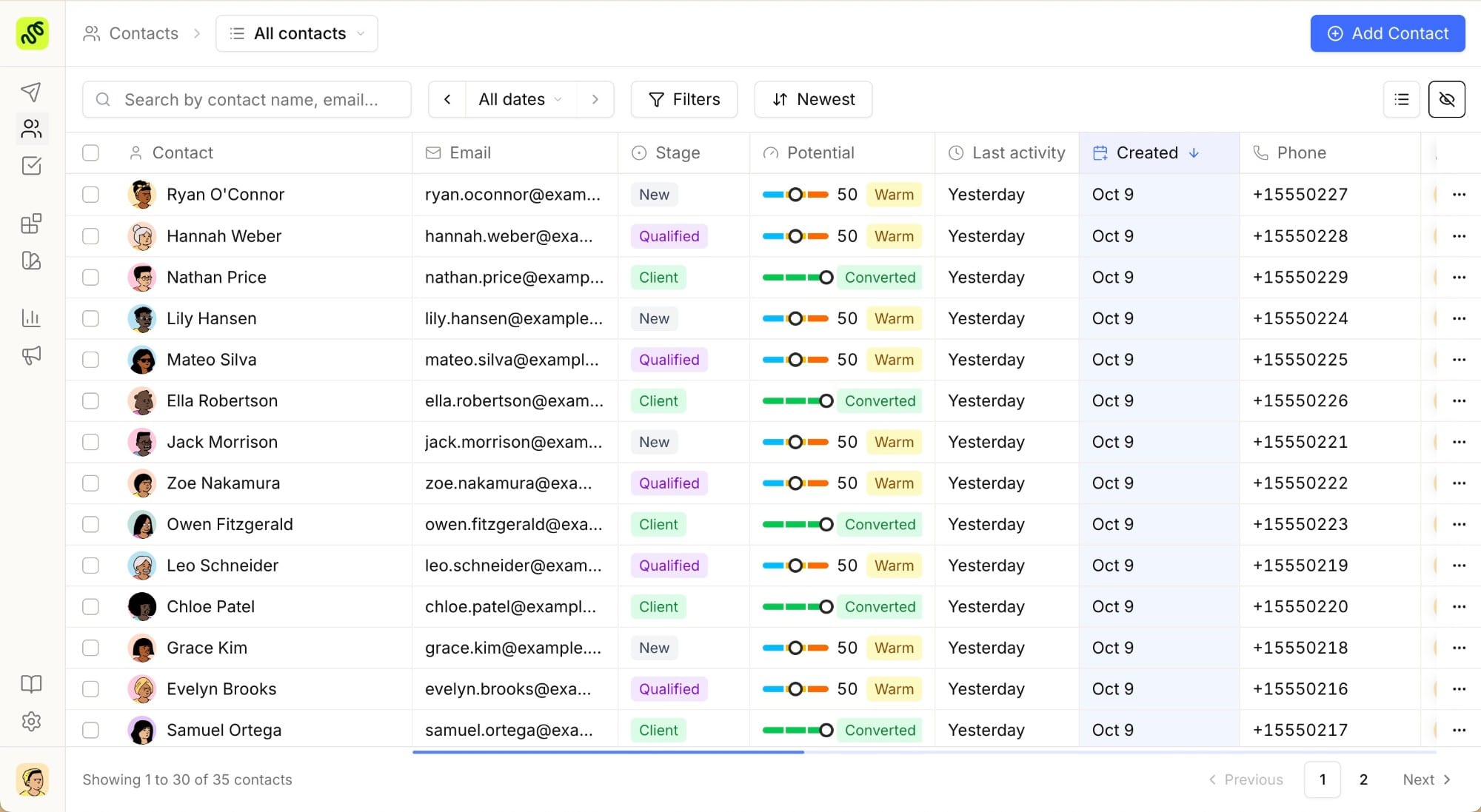
| Built-in CRM | Yescontacts, trips, pipeline | Yes), contacts, leads, pipeline, web forms, tasks |
| Commission tracking | Strong: splits, reconciliation, payouts | Via export / Zapier / Make / API |
| Booking analytics | Commission and performance reporting | Real-time dashboard: conversion + revenue KPIs |
| Multi-language proposals | Limited | 66 languages to choose from |
| AI tools | AI assistant + notetaker | Not the core focus |
| Hosting / compliance | US-based | EU, SOC 2 compliant |
Both tools are transparent about pricing and cover the itinerary-plus-CRM core. The differences are about audience and emphasis: Tern leans into US commission and host-agency plumbing; TravelBuilderPro leans into proposal design, conversion analytics, and a lower entry price.
The differences that actually matter
Pricing and the on-ramp
Tern’s plans start at $35 per user per month and scale by seat count. That is competitive for a paid, advisor-grade platform. TravelBuilderPro publishes Starter from €22 per user per month billed yearly, so the gap widens with every seat you add. Neither tool has a permanent free tier: both let you evaluate first, Tern on a free trial, TravelBuilderPro on a 7-day trial that unlocks every feature of the plan you pick, with nothing charged until it ends.
Who each tool is built for
Tern is unmistakably built for the US host-agency world: commission splits, sub-agency structures, and consortia relationships are first-class. If that is your reality, it is a real advantage. If you are an independent designer, a DMC, or an agency selling tailor-made trips outside that ecosystem, much of that machinery does not apply, and a platform built around proposal design and a general-purpose travel CRM may map more cleanly to your day.
Commission reporting vs proposal conversion analytics
This is the sharpest split. Tern’s reporting is oriented around commissions, what you booked and what you are owed. TravelBuilderPro’s analytics is oriented around the sales funnel, which proposals get opened, which convert, and where revenue comes from. Neither is “better” in the abstract; they answer different questions. Advisors focused on getting paid correctly will value Tern’s model. Advisors and agency owners focused on lifting the booking rate will value conversion analytics.
Selling to international clients
If your clients span countries and currencies, language coverage stops being cosmetic. TravelBuilderPro ships proposals in 66 languages to choose from and supports multi-currency pricing out of the box: useful for DMCs and designers selling across borders. Tern’s strength is concentrated on the US market, where that breadth is less of a daily need.
When Tern is the better choice
Be honest with yourself here. Tern wins outright when:
- You are a US advisor working under a host agency, and clean commission splits and payout statements are a weekly need.
- You rely on consortia relationships (Virtuoso, Signature, Travel Leaders Network) and want a tool built around them.
- AI-assisted note-taking and planning are high on your wishlist.
- The higher per-seat price is worth paying to you for the host-agency commission engine.
When TravelBuilderPro is the better choice
TravelBuilderPro tends to fit better when:
- You are an independent designer or a small-to-mid agency moving off Word, Canva, and spreadsheets, and want a free way to start.
- You sell internationally and need multi-language, multi-currency proposals without add-ons.
- You care about proposal conversion (seeing which quotes clients open and book), not just commission totals.
- You want a built-in CRM with web forms and a lead pipeline, plus an itinerary builder and analytics, in one place.
- EU hosting and SOC 2 compliance matter to you or your clients.
How to switch from Tern
Migrating is lighter than it looks. Most advisors start by exporting contacts to CSV and importing them on day one. A couple of signature trips get rebuilt as reusable templates during the 7-day trial, so your next proposal goes out from the new system rather than the old one. The trial is long enough to run both tools side by side for a cycle, so you switch only once your templates and pipeline feel right, no hard cutover required.
Try TravelBuilderPro free
The fastest way to know if TravelBuilderPro is the right Tern alternative for you is to build a real proposal in it. Try every feature free for 7 days, and add your team only when you are ready.
Common questions
01Is TravelBuilderPro a good Tern alternative?
Yes, especially for independent travel designers and agencies outside the US host-agency ecosystem. Both cover itinerary building and CRM, but TravelBuilderPro adds a lower per-seat price, 66-language proposals, and conversion-focused analytics, while Tern leads on US commission and consortia workflows.
02Does Tern have a free plan?
Tern offers a free trial that unlocks the full feature set, but its published plans are paid, starting at $35 per user per month (Tern pricing, 2026). TravelBuilderPro opens every signup with 7 days free and every feature unlocked, then €22 per user per month billed yearly. Neither tool has a permanently free tier.
03Does TravelBuilderPro handle commission tracking like Tern?
Commission reconciliation with automatic splits and payout statements is a core Tern strength for host agencies. TravelBuilderPro handles commissions through export and integrations (Zapier, Make, API) rather than a built-in host-agency payout engine, and instead focuses its reporting on proposal conversion and revenue.
04Which is better for international travel agencies?
For agencies selling across countries and currencies, TravelBuilderPro’s 66-language proposals, multi-currency pricing, and EU hosting are usually the better fit. Tern’s strengths are concentrated on the US advisor and host-agency market.
05Can I try TravelBuilderPro before paying?
Yes. Every signup opens with a 7-day trial of every feature in the plan you pick. You add a card at signup but nothing is charged during the trial; cancel before day 8 and you pay nothing.
Summarize this article with AI
Opens your assistant with the question already written.