If you run a travel agency, you have probably weighed a travel CRM vs itinerary builder at some point. One tool keeps your clients and leads organized. The other turns a trip idea into a proposal a client will actually book. They solve different problems, they overlap more than their names suggest, and most agencies eventually ask the same question: do you need both, or a single platform that does the job of each? This guide explains what each tool really does, where the lines blur, and how to decide based on your agency’s size and workflow rather than a vendor’s feature list.
What a travel CRM does
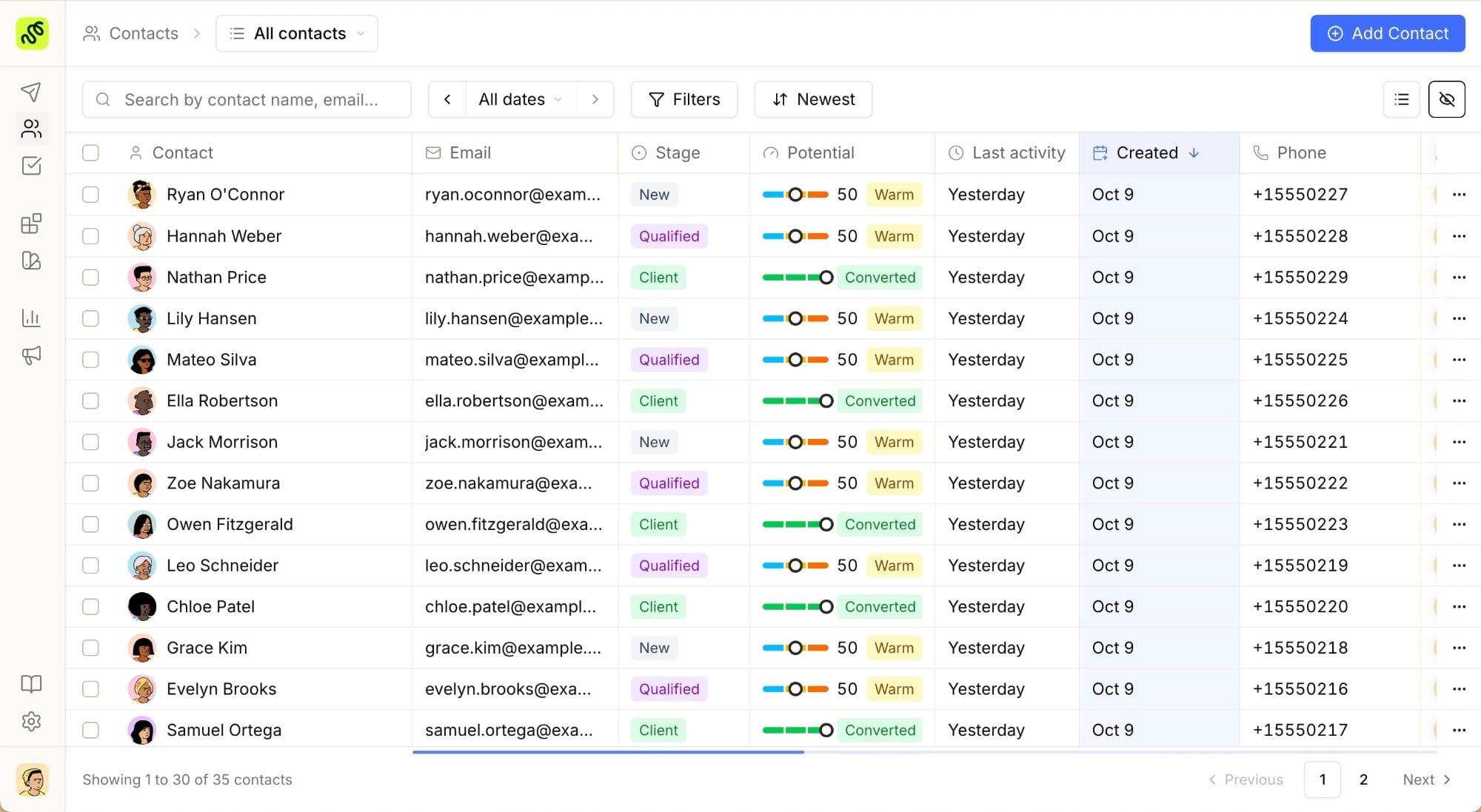
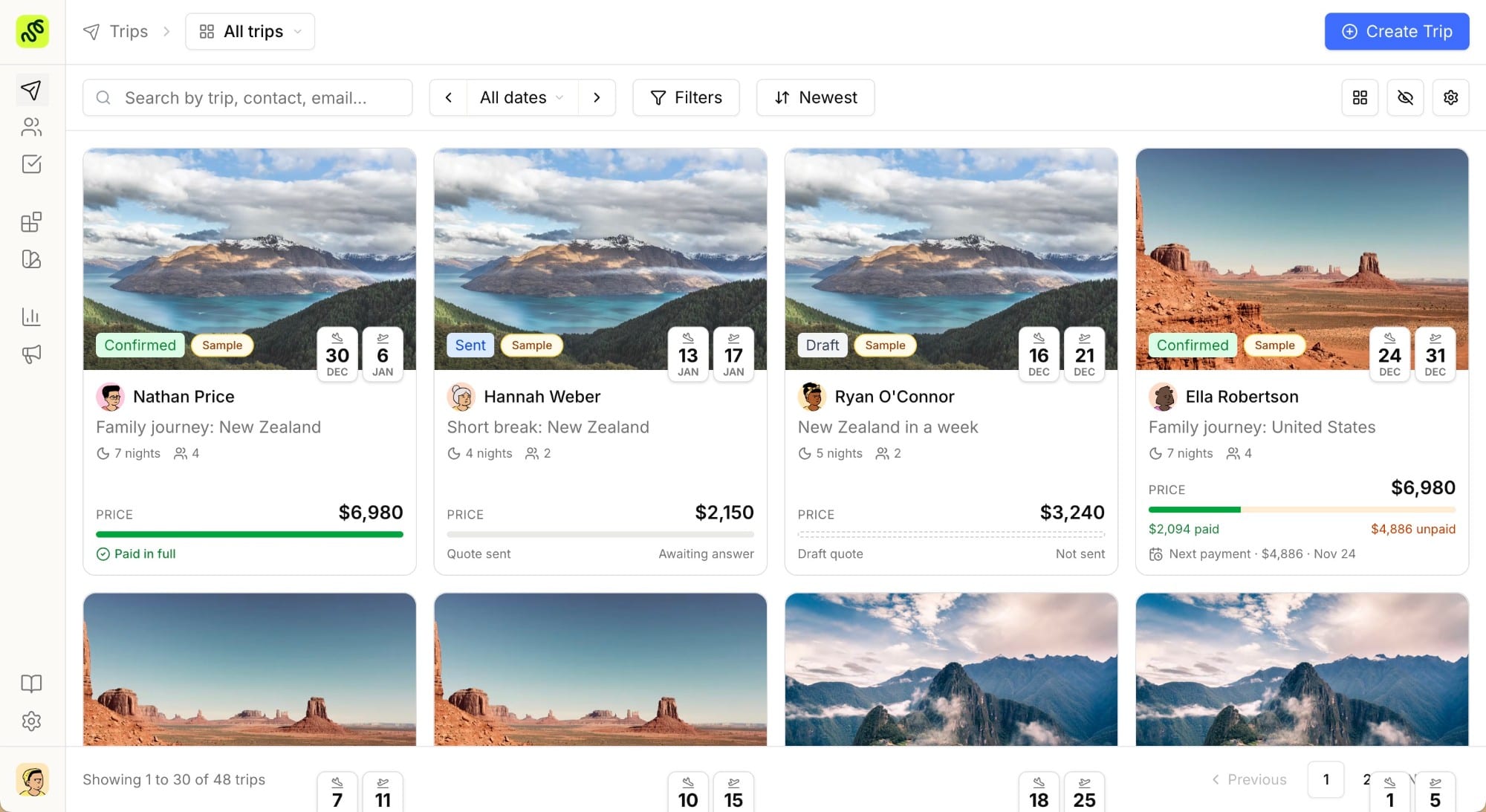
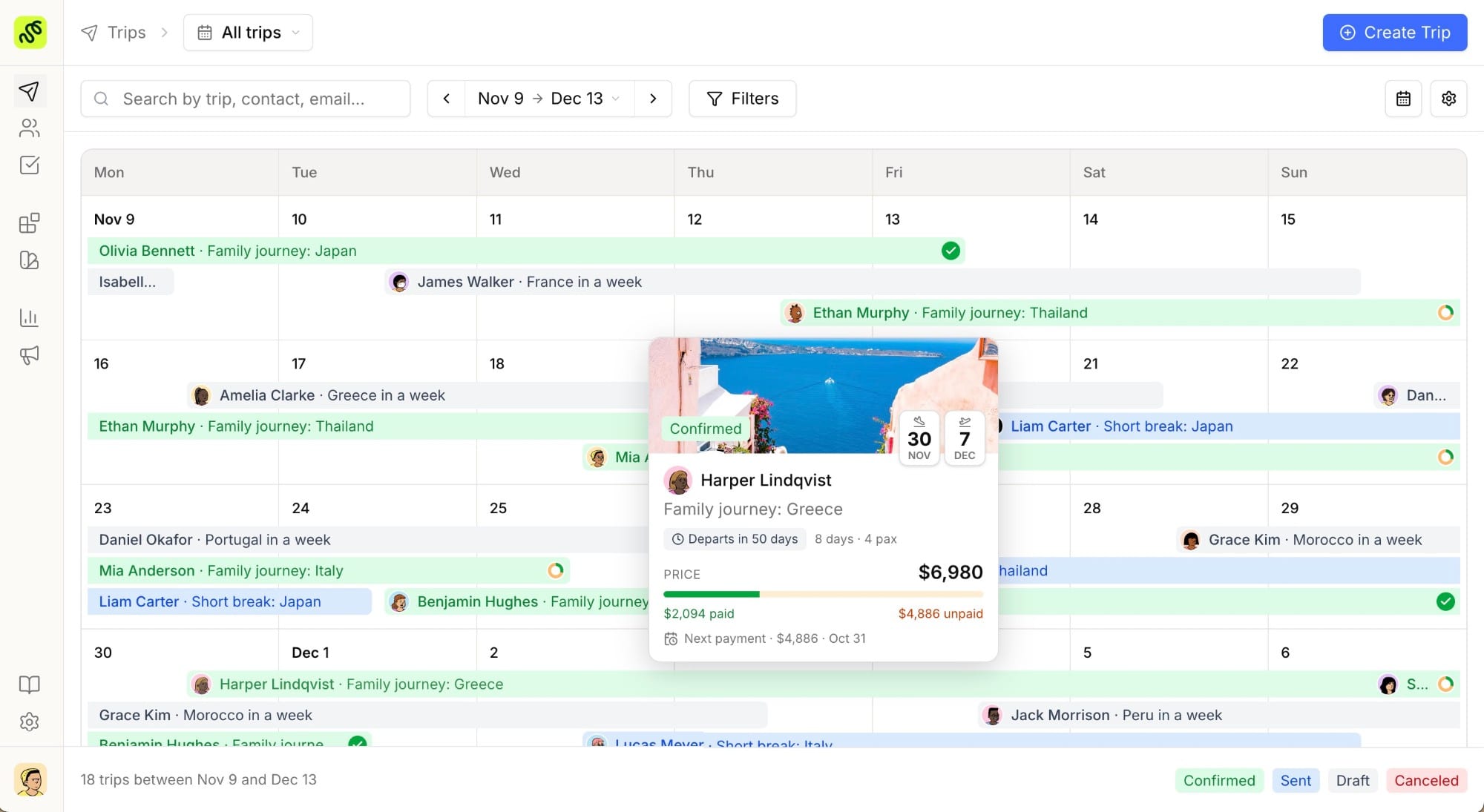
A travel CRM is the system of record for your relationships. It stores client profiles, travel history, preferences, and documents, and it tracks every lead from first inquiry to booked trip. The useful ones add a pipeline so you can see which prospects are waiting on a quote, which need a follow-up, and which have gone cold.
The core job is memory and momentum. A CRM remembers that a past client always flies premium economy, that a honeymoon couple asked about Japan in March, and that a corporate account books the same retreat every autumn. It then nudges you to act: send the follow-up, confirm the deposit, check in before departure. When several advisors share the same Pipeline, nobody has to reconstruct a client’s context from a buried email thread.
What a CRM does not do well is design the trip itself. A generic CRM like a horizontal sales tool can store a deal, but it has no concept of a day-by-day route, a supplier rate, or a branded proposal. That is where the second tool comes in.
What an itinerary builder does
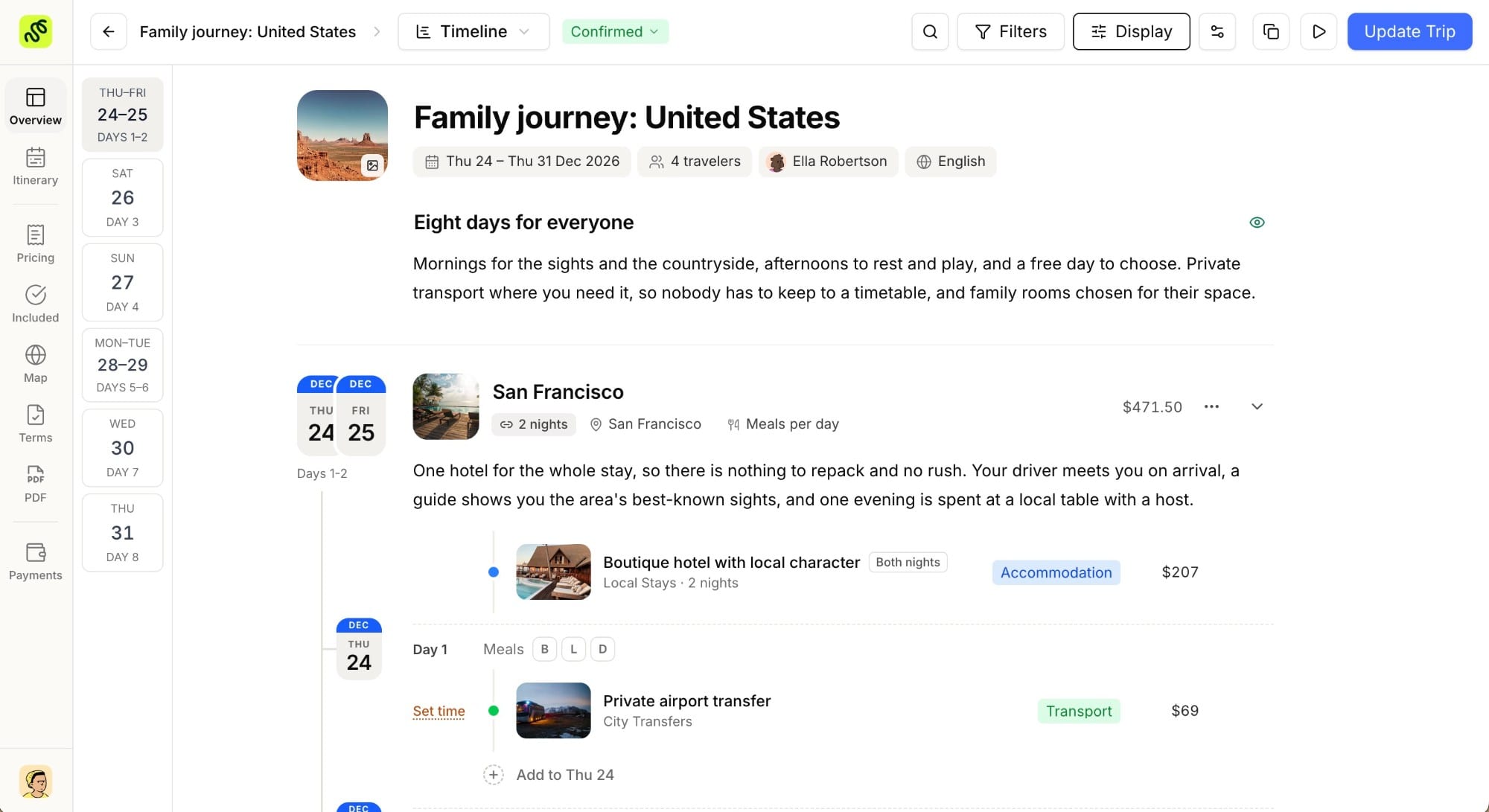
An itinerary builder turns a loose trip idea into a structured, client-facing document. It sequences flights, transfers, hotels, and activities into a clear day-by-day plan, prices the components, and exports or shares a proposal the client can read, compare, and approve.
A good builder is where your craft shows. It handles pacing and logistics, reuses content you have written before, and produces something that looks considered instead of pasted together in a word processor. TravelBuilderPro’s itinerary builder adds multi-language proposals and branded output so the document matches your agency rather than the software.
What a standalone builder does not do is manage the relationship around the trip. Once the proposal is sent, a pure builder rarely tracks whether the lead replied, when the balance is due, or how many of this quarter’s proposals turned into bookings. Those gaps are exactly why the two categories keep bumping into each other.
Travel CRM vs itinerary builder: where they overlap
The honest answer is that the two tools share a border, and travel-specific products increasingly cover both. Many travel CRMs include a built-in builder, and some builders bolt on light contact management. So the real decision is less “CRM or builder” and more “two focused tools, or one platform that spans both?”
Here is how the capabilities line up across three common setups.
| Capability | Standalone itinerary builder | Standalone or generic CRM | Combined travel platform |
|---|---|---|---|
| Client database and history | Limited | Yes | Yes |
| Lead pipeline and follow-ups | No | Yes | Yes |
| Day-by-day itinerary design | Yes | No | Yes |
| Branded, client-facing proposals | Yes | Rarely | Yes |
| Supplier and rate records | Sometimes | No | Yes |
| Booking and payment tracking | Rarely | Partial | Yes |
| Conversion and revenue analytics | No | Partial | Yes |
| Team collaboration on one trip | Partial | Partial | Yes |
| Client, proposal, and booking in one record | No | No | Yes |
The pattern is clear. A standalone builder is strong on the proposal and weak on the relationship. A generic CRM is strong on the relationship and has no idea how to build a trip. A combined travel platform covers both columns, at the cost of asking you to standardize on one system.
Do you need both?
It depends on volume and team size more than anything else.
Solo advisor, low volume. If you own every trip end to end and send a handful of proposals a month, you can often get by with one strong tool. A lightweight builder plus a simple contact list, or a single travel CRM with a built-in builder, is usually enough. Two paid subscriptions is overkill at this stage.
Growing agency, a few advisors. This is where two disconnected tools start to hurt. When the client record lives in one app and the proposal lives in another, someone has to reconcile notes, payment status, and supplier changes by hand. Leads slip because the follow-up lived in the builder, which has no reminders. A shared CRM with the itinerary work attached to the same client record removes that reconciliation tax.
Multi-advisor or high volume. At this stage the cost of fragmentation is measurable: lost context on handoffs, no reliable pipeline view, and no clean way to see conversion. You want one record per client that carries the inquiry, the proposal, the booking, and the follow-up, so any advisor can pick up any trip.
So “both” is often the wrong frame. Very small operations need roughly one tool’s worth of capability. Everyone larger needs the capability of both, which they can get as two integrated tools or, more simply, as one platform.
When one platform beats two tools
Two tools can work if they integrate cleanly and the integration keeps working. The friction shows up in the seams: data entered twice, a proposal that does not know the deposit was paid, a pipeline that cannot report on proposal conversion because the proposals live elsewhere.
A combined platform removes the seams by design. The proposal is attached to the client, the booking updates the pipeline, and the numbers roll up into one analytics view instead of being stitched together in a spreadsheet. That is the case for an all-in-one approach, which we cover in more depth in all-in-one travel agency software vs separate tools.
The trade-off is lock-in and fit. One platform means one vendor, so evaluate it the way you would any core system: does the builder produce proposals you are proud to send, does the CRM match how your team actually sells, and is the pricing transparent and predictable as you add seats? If the answer is yes on all three, one platform usually beats two.
How to decide
Run your own situation through four quick checks before you buy anything.
- Count your monthly proposals. Single digits favors one focused tool. Dozens, across more than one person, favors an integrated setup.
- Find where things fall through. If leads go cold, the relationship side is your gap. If proposals look rushed, the builder side is. Fix the weaker column first.
- Test the seam, not the feature list. If you compare two tools, run a real trip from inquiry to booking and watch whether data has to be re-entered. If you compare one platform, check that both halves are genuinely good, not one good half and one afterthought.
- Check the total cost as you grow. Two subscriptions plus the time spent reconciling them is the real price of the two-tool route. Weigh it against a single per-seat platform.
Try it on your own trips
The fastest way to settle the travel CRM vs itinerary builder question is to run one real trip through a platform that does both and see whether the seams disappear. Try every feature free for 7 days: the trial unlocks the full itinerary builder, CRM, and analytics, and converts to the plan you choose unless you cancel. Build a proposal, attach it to a client, and watch the pipeline update in one place.
Common questions
01Is a travel CRM the same as an itinerary builder?
No. A travel CRM manages clients, leads, and follow-ups. An itinerary builder designs and prices the trip and produces the client-facing proposal. Some travel CRMs include a builder, but the two jobs are distinct.
02Can I use a generic CRM like a general sales tool for my travel agency?
You can, but you will build the travel parts yourself with custom fields and workarounds, and it still will not design itineraries. A travel-specific tool understands trips, suppliers, and proposals out of the box, which saves significant setup time.
03Do small travel agencies need both tools?
Usually not as two separate subscriptions. A solo advisor with low volume can work from one strong tool. The need for both capabilities grows with team size and proposal volume, at which point a single combined platform is often simpler than two.
04What happens if my itinerary builder and CRM do not talk to each other?
You get double data entry and blind spots: proposals that do not reflect payments, pipelines that cannot report conversion, and lost context on handoffs. Clean integration or a single platform avoids this.
05Should the itinerary and the client record live together?
Ideally yes. When the proposal, booking, and follow-up all hang off one client record, any advisor can pick up any trip, and your reporting is accurate without manual stitching.
Summarize this article with AI
Opens your assistant with the question already written.