To present flights in a travel itinerary well, show the client only the details they actually need to feel safe, airline, flight number, local departure and arrival times, duration, layover airport and length, and the practical notes like terminal, cabin, and baggage, laid out so each segment reads at a glance. The raw string your GDS spits out is not that. After a decade running trips as a tour operator, I learned that the flights are the first thing an anxious client checks and the last thing most proposals format with any care. Here is how I lay them out so they reassure instead of confuse.
Why the flights carry more weight than you think
Everything else in a trip is a promise about the future. The flights are the one part the client can check against reality the moment they open the proposal, and they do. They know what time they like to leave, they have a sense of what a sane connection feels like, and they will spot a red-eye or a five-hour layover faster than they will read your description of the vineyard lunch.
So the flight block is doing quiet trust work. A clean, readable set of segments says this person has thought about my day door to door. A wall of airport codes and 24-hour times with no duration and no layover note says the opposite, even when the routing underneath is perfect. The routing is your expertise. The presentation is what lets the client see it.
What to show for every flight (and what to cut)
The goal is enough to reassure, not a ticketing screen. For each segment, include:
- Airline and flight number. Clients recognise carriers, and the flight number is what they will track on the day.
- Date and local times. Departure and arrival in the local time of each airport, not UTC, not your home time zone. Label them as local.
- Airports, named.
London Heathrow (LHR), not justLHR. The code confirms it, the name is what the client reads. - Flight duration. The single most reassuring number on the line. It tells the client how long they are actually in the air without doing time-zone math.
- Cabin. Economy, premium, business. They are paying for it, so name it.
- Baggage. Checked allowance and whether it is included. Baggage is the most common day-of surprise, and spelling it out once in the proposal saves a frantic message at the airport.
What to leave off the client-facing view: fare basis codes, booking classes (the letter after the cabin), equipment types unless the client is an aviation enthusiast, and anything from the ticketing layer that means nothing to a traveller. You keep those in your own records. The client sees the human version.
Format each segment so it reads at a glance
A flight block fails when the client has to work to decode it. Three formatting habits fix most of that.
Give every segment its own line or card. One outbound, one return, each connection on its own row, in travel order. Never merge a connection into one line, two flights crushed together is where clients miss that they change planes at all.
Make the duration and the layover explicit. Between two connecting flights, add a plain line: Connection in Doha: 2h 10m. The client should never have to subtract one time from another to work out whether a connection is tight.
Flag the overnight and the next-day arrival. The single most misread thing in any flight itinerary is the flight that lands the day after it departs. Write it in words: arrives 06:15 the next morning (+1 day). A client who books a first-night hotel for the wrong date because your proposal showed a bare 06:15 will remember whose fault it felt like. Time zones cause the same trap on long hauls: when you state arrival in local time and give the duration, the client can see that a 10-hour flight landing “two hours after” departure crossed the date line, rather than being baffled by it.
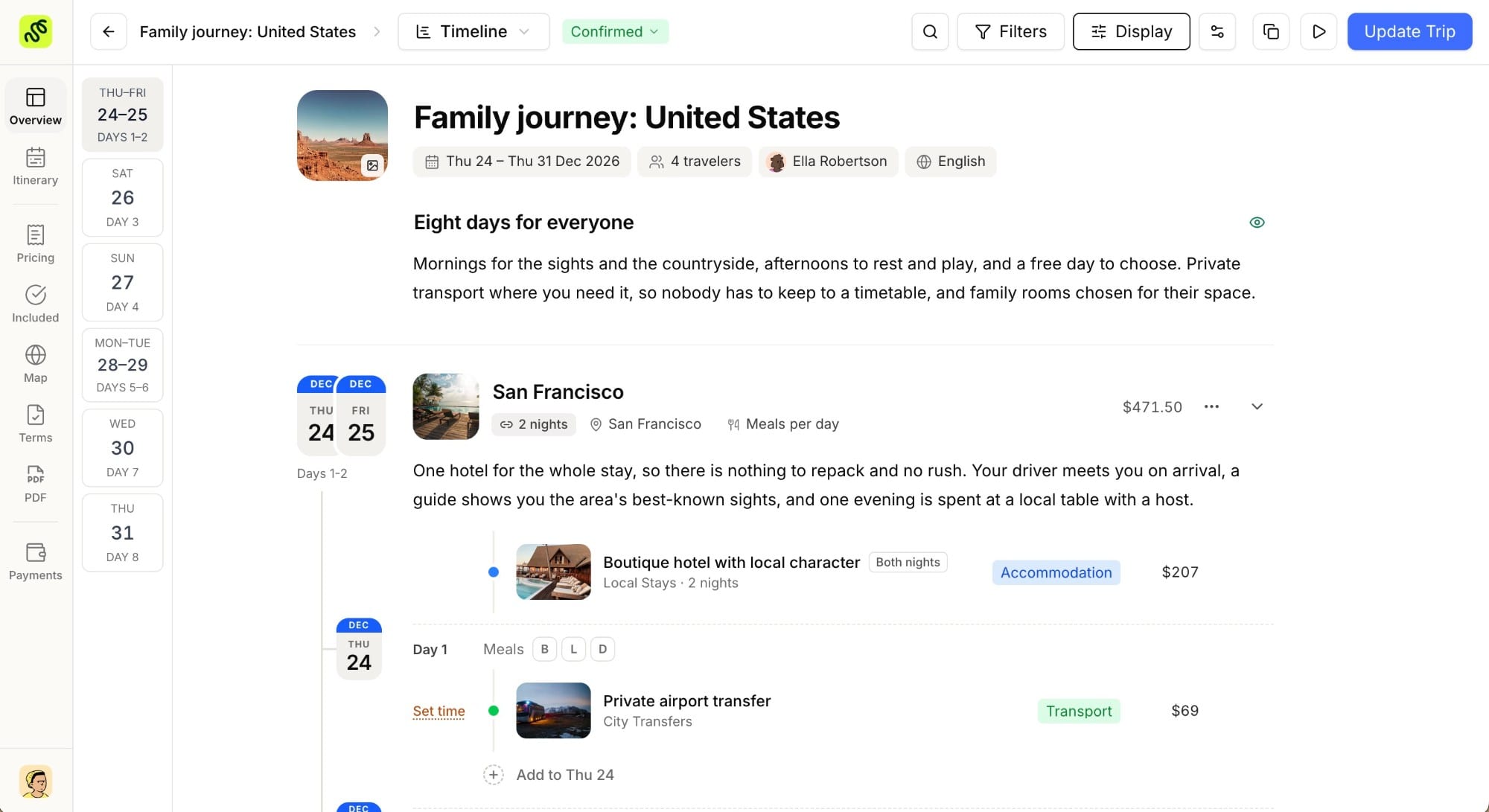
Where you build the trip matters here too. A good itinerary builder formats flight segments into consistent blocks for you, so every proposal shows times, duration, and layovers the same way, instead of you hand-typing a GDS dump into a document and hoping you caught the +1.
Handling layovers and connections
Layovers are where good routing either reassures or alarms, depending entirely on how you present it.
Show the connection time, and reassure on the tight ones. If a connection is legal but short, say why it is fine: same terminal, bags checked through, airline-protected. As a rough rule of thumb, a domestic-to-domestic connection in the same terminal is comfortable around 45–60 minutes, while a connection that involves immigration and re-screening wants more like 1.5–2 hours. Treat those as starting points, not guarantees: every airport sets its own minimum connection time, so confirm the specific one before you commit a routing, then present it with the confidence that check earned you.
Name the long and overnight layovers as a choice, not an accident. A six-hour layover looks like a mistake unless you frame it: a cheaper fare, a chance to leave the airport, or the only sensible routing that day. If it is an overnight, say where the client sleeps. Silence on a long layover reads as carelessness.
Spell out the self-transfer risk. If two flights are on separate tickets and the bags do not check through, the client needs to know they collect and re-check, and that a missed connection is on them, not the airline. This is the one place where under-explaining can genuinely cost your client money, so never bury it.
For open-jaw and multi-city trips, present the flights in the order the client flies them, and add a one-line note for any ground travel between the arrival and the next departure point, so there is no silent gap where the client wonders how they get from the city they landed in to the one they fly out of.
The flights you are not booking
Plenty of clients book their own long-haul flights and leave you the land arrangements. Present those too, even though you did not sell them. A trip where the agent-booked content floats without the client’s own flights around it feels half-built, and it is also where arrival-time mistakes hide.
Ask for the client’s flight details early, in the client questionnaire or trip brief stage, and drop them into the itinerary clearly marked as your own flights so the responsibility is unambiguous. When the arrival time drives your first-day transfer and hotel check-in, you want it on the page, not in an email thread. And when flights genuinely are not part of your service, say so in one line, International flights are not included in this proposal, rather than leaving the client to guess.
The mistakes that make a client nervous
Most flight blocks go wrong in a handful of predictable ways. I have shipped all of these at least once.
- Mismatched airport codes. One wrong letter and
LHRbecomes an airport in another country. Always check the code against the city name, because a client who spots it stops trusting everything else on the page. - 24-hour times with no am/pm cue for clients who don’t think that way. If your market reads clocks in 12-hour time, give them 12-hour time. Small courtesy, fewer 3am-versus-3pm panics.
- No duration and no layover line. The two numbers that do the most reassuring, left off. Add them.
- Burying the flights. Flights pushed to a back page while the pretty photos lead. The client wants to find their routing in two seconds. Put a clean flight summary near the top of the trip, not in an appendix.
- Forgetting the practical lines elsewhere. Flights are also where it is tempting to drop the payment and balance-due dates. Keep those visible in the proposal regardless, flights and money are the two things clients reread.
Where to present flights in a travel itinerary
A flight block written this carefully deserves a container that keeps it readable. A static PDF goes stale the moment a schedule changes, and airline times change often. When you share the proposal as a live link, a time change or a re-routed connection updates in place, and the client is always looking at the current version rather than a printout from last week. That alone removes a whole category of day-of confusion.
Keep the flights near the top as a scannable summary, then let them reappear in context on the right day, the outbound on day one, the return on the last day, so the client sees them both as an overview and as part of the journey. Presented that way, the flights stop being the scary part of the proposal and start being the part that proves you planned the whole trip, gate to gate.
Put your flights where clients can read them
Flights are the first thing a nervous client checks, so presenting them well is some of the cheapest trust you can buy: show what reassures, cut what confuses, make layovers and next-day arrivals impossible to misread, and keep the routing near the top where it belongs.
TravelBuilderPro gives travel professionals one workspace to build itineraries, format flight segments consistently, and send proposals as live links clients actually read. Every signup starts with a 7-day full-feature trial: every feature unlocked, and nothing charged until it ends.
Common questions
01What flight details should a travel itinerary include?
Airline and flight number, the date, local departure and arrival times, flight duration, both airports with names and codes, cabin, and checked-baggage allowance. For connections, add the layover airport and its duration. Leave out fare basis codes and booking classes: they mean nothing to the traveller and belong only in your own records.
02How do I show a flight that arrives the next day?
Write it in words rather than relying on the time alone: arrives 06:15 the next morning (+1 day). A bare arrival time is the single most misread element in a flight itinerary, and it leads clients to book the wrong first-night hotel date. Stating arrival in local time and giving the duration lets the client see that the flight crossed into the next day.
03How much layover time should I leave for a connection?
Enough to be safe for that specific airport, which sets its own minimum connection time. As a rough guide, 45–60 minutes can work for a same-terminal domestic connection, while a connection involving immigration and re-screening usually wants 1.5–2 hours. Always confirm the airport’s and airline’s own minimum before committing a routing, and present tight-but-legal connections with a short note explaining why they are fine.
04Should I include flights the client booked themselves?
Yes. Add them to the itinerary clearly marked as the client’s own flights so responsibility is unambiguous, especially when their arrival time drives your first-day transfer and check-in. A trip that shows your land arrangements without the surrounding flights feels half-finished and hides arrival-time errors.
05Where should flights go in a travel proposal?
Near the top, as a clean, scannable summary the client can find in seconds, and then again in context on the relevant day. Do not bury the routing in an appendix behind the photos: flights and payment dates are the two things clients reread most, so both should stay easy to find.
Summarize this article with AI
Opens your assistant with the question already written.