Most travel itinerary descriptions read like a logistics manifest: arrive, check in, free afternoon, dinner at 7. Accurate, and completely forgettable. The descriptions that actually sell a trip do one thing differently. They let the client feel the day before they’ve paid for it. After a decade running trips as a tour operator, I learned that the words wrapped around each activity move the booking almost as much as the price does. This is how I write travel itinerary descriptions that sell: a repeatable method you can apply to every proposal, not a flash of inspiration you hope shows up on deadline.
Sell the day, not the schedule
A schedule answers what happens. A description answers what it will feel like, and why it’s worth it to you. Those are two different jobs, and most proposals only do the first one.
Here’s the same morning written both ways.
Schedule: Day 3: Private guide, 9:00. Old town walking tour (3h). Lunch not included. Afternoon free.
Description: You’ll meet Marco, your guide, just as the old town is waking up and the cafés are setting out their first tables. Over three unhurried hours he’ll walk you past the cathedral most tour groups photograph and never enter, into the backstreet workshops where the city’s leatherworkers still cut by hand. By noon you’ll know the place well enough to wander it on your own, which is exactly what the free afternoon is for.
Same logistics. Same cost line. One of them makes the client picture themselves there; the other makes them do mental math. The first version is a spreadsheet row. The second is the reason they say yes.
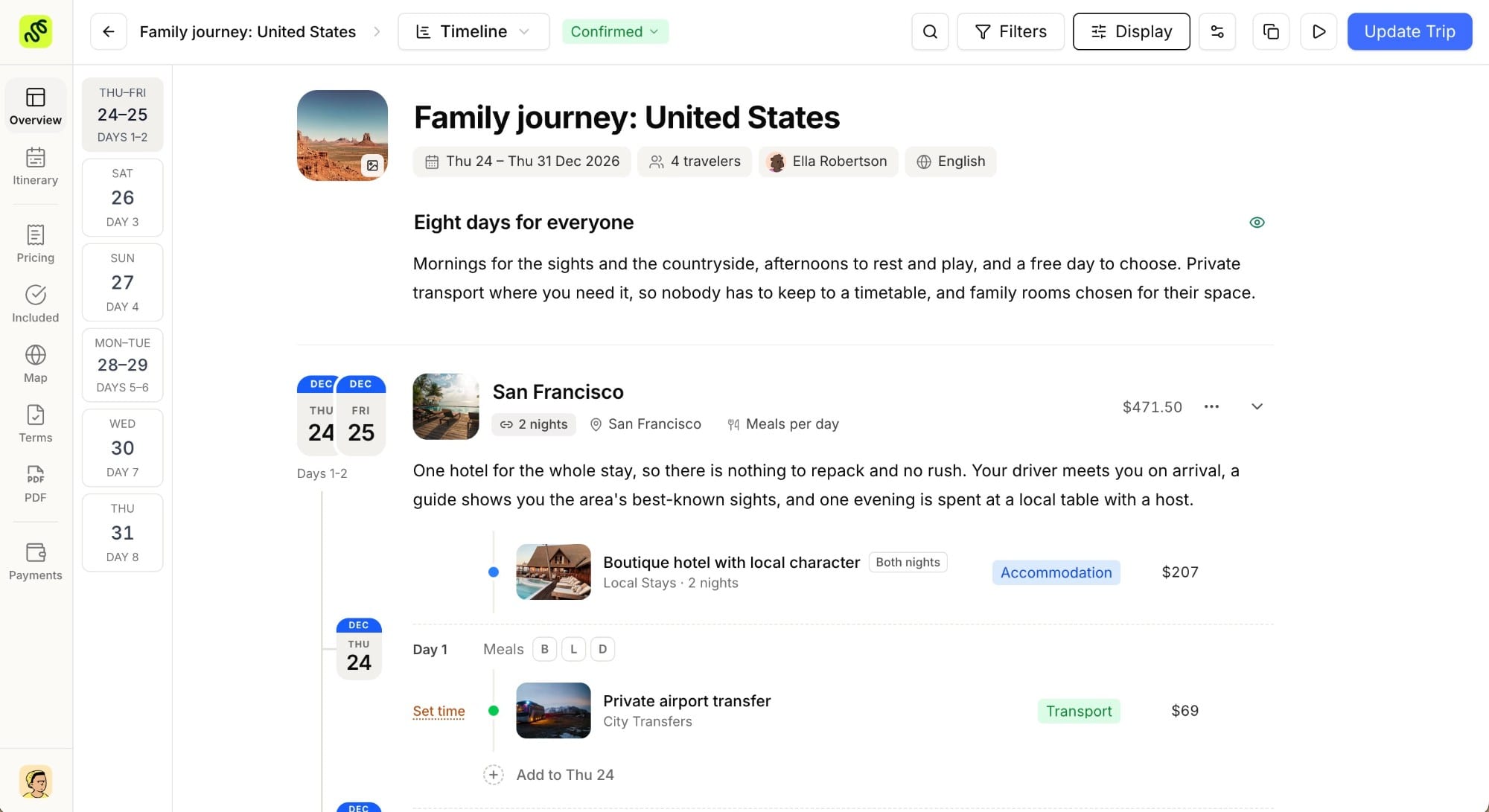
The reframe is simple: before you write a single day, decide what the client should feel, then let the facts serve that feeling. A good itinerary builder gives you the structure and the sequence: the words that make it desirable are still yours to write.
The anatomy of a description that sells
When I’m stuck, I fall back on the same four-beat structure for every day or activity. It’s boring to name and reliable to use.
- Open with the experience. Lead with the moment, not the transport. Not “Transfer to the vineyard for a tasting” but “By late morning you’re standing between the vines, glass in hand, while the winemaker explains why this slope ripens a week ahead of the valley floor.”
- Ground it in specifics. One or two concrete, checkable details: a name, a dish, a time of day, a texture. Specifics are what separate a real recommendation from a template.
- Connect it to this traveler. A short line that ties the moment to why it’s in their trip. “You mentioned you wanted to slow down after the cities. This is that day.”
- Close with the practical line. End on the logistics, briefly, so they feel taken care of: pace, what’s included, how much walking, when they’re back. Reassurance belongs at the end, not the front.
Put together, the beats read as one natural paragraph. The reader never sees the seams. The structure just guarantees you never open a day with a parking note.
Specific beats generic, every time
The fastest way to make a description invisible is to reach for the words every brochure already uses. Stunning views. Charming village. Hidden gem. Authentic local experience. Clients have read those a thousand times; their eyes slide right off them.
Detail is what earns trust. Compare “enjoy a wonderful local dinner” with “dinner is at a family-run trattoria where the nonna still makes the pasta by hand and there’s no printed menu: you eat what the kitchen cooked that morning.” The second one costs you fifteen extra seconds and signals that you actually know the place. That signal is doing quiet sales work: it tells the client you’ll be this specific about their whole trip, not just this dinner.
You don’t need a specific for every line. You need one or two per day that only someone who knows the destination could have written. Those are the details that make the client stop comparing you on price.
Write for one traveler, not a brochure
A description that sells is written to someone, not about a place. That’s the difference between a travel designer and a catalog.
Use what you learned in the first conversation. If they told you they’re celebrating an anniversary, the sunset dinner isn’t “a romantic option”: it’s “the evening I’d build the whole trip around for the two of you.” If they’re traveling with teenagers, the same hike gets framed around the swim at the end and the fact that there’s phone signal at the summit. The activity can be identical; the description changes because the reader changed.
Pace matters too. A honeymoon reads slow and sensory. A family FIT trip reads practical and reassuring. Parents are scanning for “how far, how hard, is there a fallback if it rains.” Match the rhythm of your writing to the rhythm of the trip you designed. When every day is written at the same breathless intensity, none of them land; the reader needs quiet days on the page as much as in the itinerary.
Second person is your friend here. “You’ll arrive…” pulls the reader into the trip. “Clients will be met by…” pushes them back out into a policy document.
The mistakes that flatten a description
Most weak itinerary copy fails in one of a few predictable ways. I’ve made all of these.
- Adjective soup. Stacking breathtaking, unforgettable, world-class in place of one real detail. Superlatives are a promise; specifics are proof.
- Pasting the supplier’s marketing copy. The hotel’s own blurb is written to sell to everyone, which means it sells to no one in particular. Rewrite it for your client.
- Front-loading logistics. Opening every day with the transfer time. Lead with the experience; the pickup can wait until the last line.
- No rhythm. Writing the rest day with the same energy as the summit day, so the trip reads flat. Let the calm days be calm on the page.
- Walls of text. A dense block nobody reads on a phone. Short paragraphs, one idea each. Most clients open your proposal on mobile. Write for that screen.
- Writing for yourself. Showing off how much you know about the region instead of what the client will do with it. Expertise should serve the traveler, not the author.
Make your best travel itinerary descriptions repeatable
Here’s the honest tension: writing like this for every proposal, from scratch, is exhausting, and exhaustion is where quality quietly slips. The answer isn’t to write less carefully. It’s to stop writing the same thing twice.
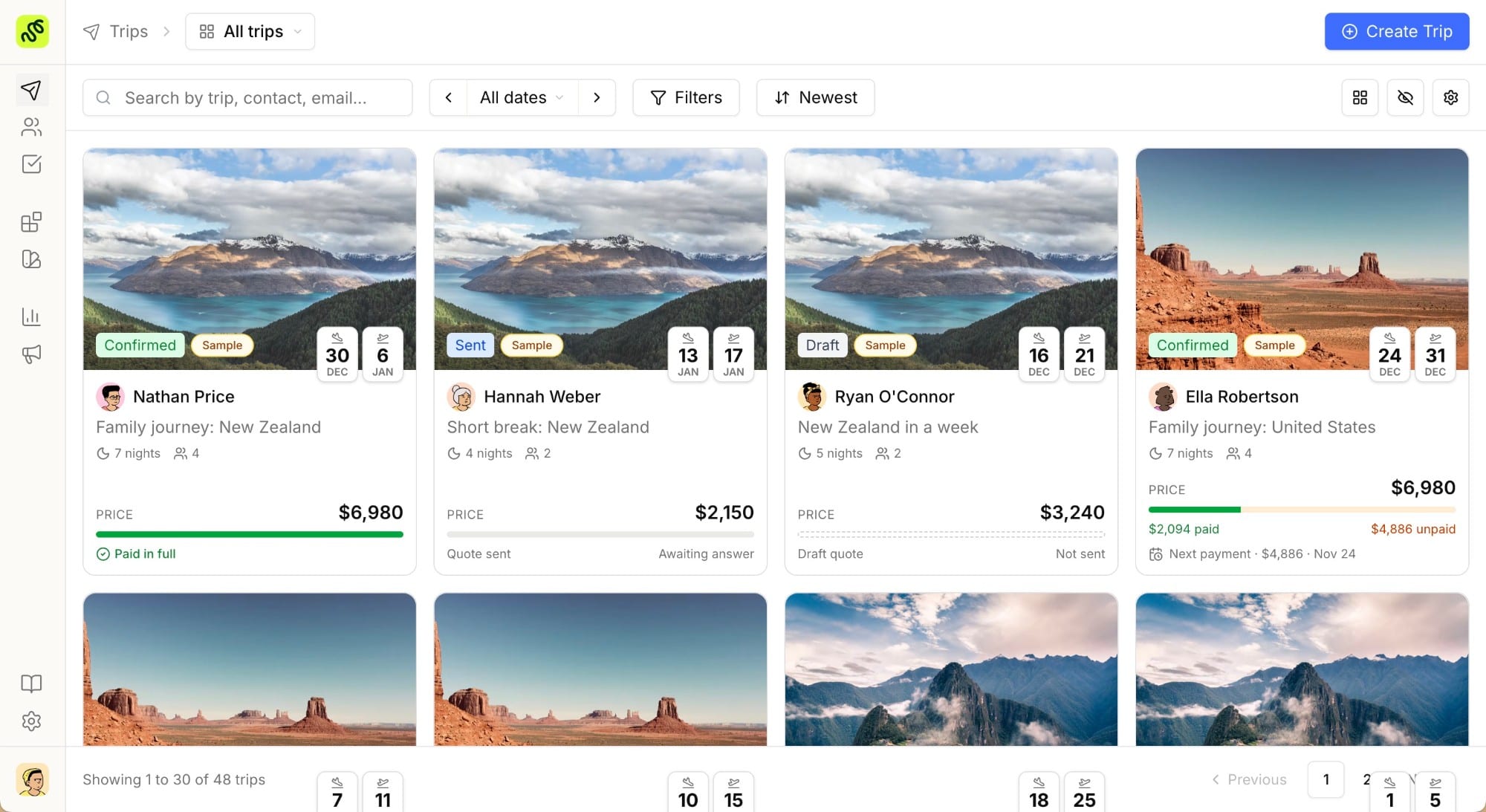
The descriptions you’re proud of are assets. The vineyard morning you nailed for one couple works, with two edits, for the next one. Save your strongest descriptions as reusable blocks and build a personal library, so your baseline quality rises every month instead of resetting with every trip. That’s most of what a tool like TravelBuilderPro is for on the writing side: you keep your best day-copy in one place, drop it into a new itinerary, and spend your energy personalizing the two or three lines that matter for this client rather than rebuilding the whole day.
It also matters where that copy lands. A description written to sell deserves better than a flat PDF attachment: share the proposal as a live link where your words sit next to real photos and the client can read it the way you wrote it, on the device they actually use. Great copy in a bad container still underperforms.
Start writing descriptions that book
You don’t need a bigger vocabulary or a longer itinerary. You need to sell the day instead of the schedule, ground it in real specifics, and write it to one traveler, then make your best copy reusable so quality doesn’t depend on how tired you are on deadline.
TravelBuilderPro gives travel professionals one workspace to build itineraries, save your strongest descriptions as reusable blocks, and send proposals clients actually read. Every signup starts with a 7-day full-feature trial: every feature unlocked, and nothing charged until it ends.
Common questions
01How long should a travel itinerary description be?
Long enough to make the day feel real, short enough to read on a phone, usually two to four sentences per day or activity for the days that matter, and a single line for genuine free time. Don’t pad transfer days to match the highlights. Length should follow importance, not a template.
02Should I use AI to write itinerary descriptions?
As a first draft or an unblocker, it’s useful. As the final voice, it’s a liability: AI defaults to exactly the generic, adjective-heavy copy that makes clients tune out, and it can’t add the specific detail that builds trust because it wasn’t in the room when you designed the trip. Use it to get words on the page fast, then add the named guide, the real dish, and the line that ties the day to this particular traveler.
03How do I make descriptions sound personal without rewriting everything?
Keep a library of strong base descriptions and change only the framing: the one or two lines that connect the activity to what this client told you they wanted. The factual core of “morning at the market” stays; the reason it’s their morning is what you rewrite each time. That’s a few minutes per proposal, not hours.
04Do itinerary descriptions really affect whether a trip books?
Yes: especially in the middle of the decision, when a client is comparing your proposal against another agency’s. When the destinations and the price are close, the words are the tiebreaker: the proposal that makes the trip feel real and made-for-them wins over the one that reads like a schedule. Descriptions are one of the few levers you fully control.
Summarize this article with AI
Opens your assistant with the question already written.