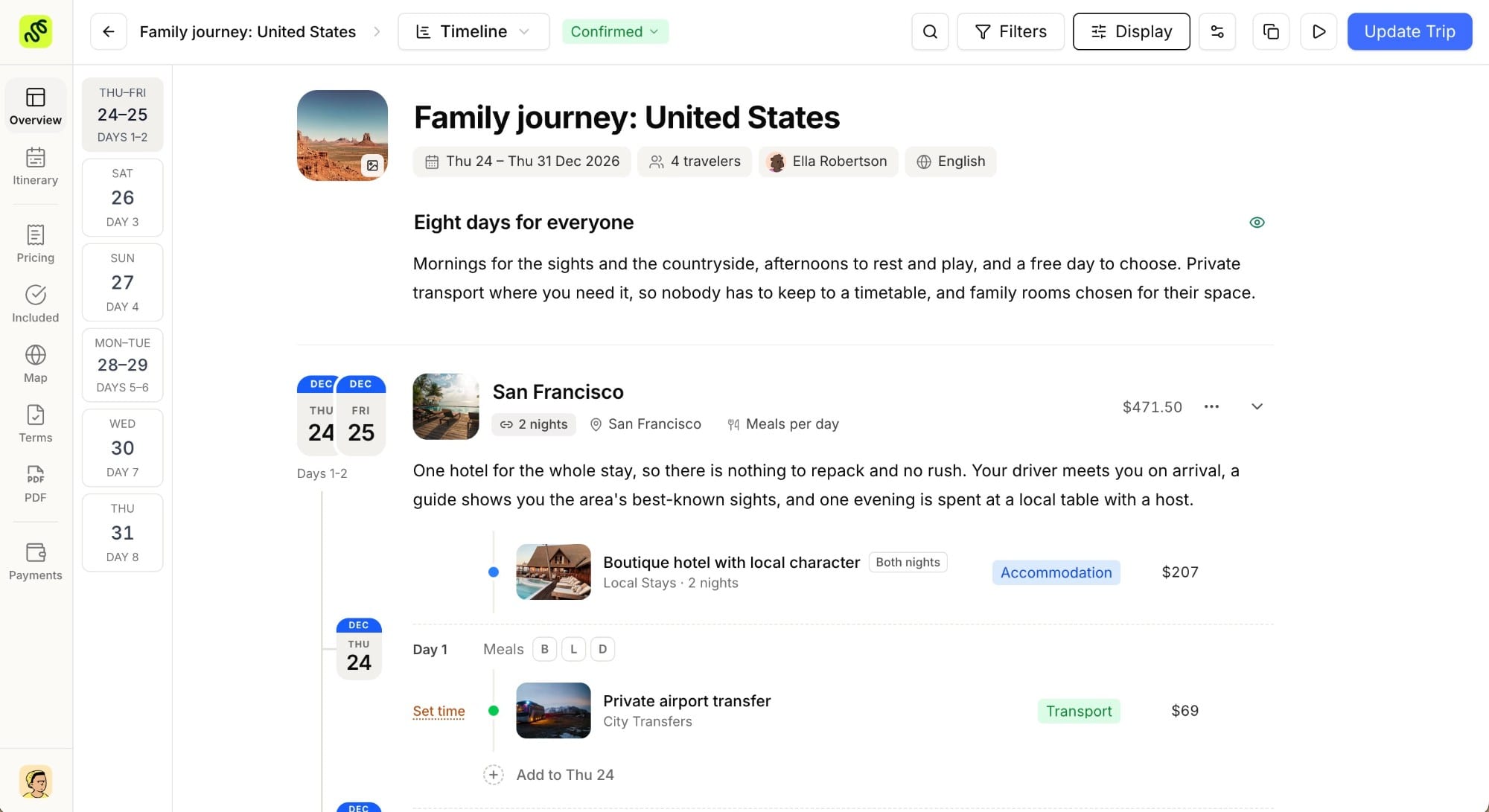
Knowing how to present a travel proposal to clients is a different skill from building one, and it’s the one most agencies skip. The best presentation is a short, guided walkthrough that explains the logic of the trip and ends with one clear next step, not a silent PDF the client is left to decode alone. Whether you do it live on a call or send it with a two-minute framing message, the goal is the same: make sure the client understands why the trip is built the way it is before they look at the price.
I spent a decade selling custom itineraries as a tour operator, and I lost more deals to a badly delivered proposal than to a badly designed one. Here’s how I learned to present a proposal so the client feels guided instead of quoted.
Why the presentation matters as much as the proposal
By the time you send a proposal, you’ve done the hard part: the discovery, the research, the pricing, the day-by-day build. Then most agencies undo it in one move: they attach the file, write “Let me know what you think!”, and hit send.
The problem is that a proposal without a presentation forces the client to interpret your work on their own. They open it, scroll to the total first (everyone does), and judge the number before they’ve understood what it buys. A trip you’d priced fairly starts to feel expensive, because the value never got explained: it just sat there as a line item.
A presentation reverses that order. You frame the thinking, walk them through the experience, and then let the price land against a story they already believe in. Same trip, same number, completely different reaction. The presentation is where the sale is actually made; the document is just the record of it.
Live walkthrough or send-and-follow-up?
Both work. The right choice depends on the client and the trip, not on a rule.
Present live when the trip is complex, high-value, or emotionally loaded: a honeymoon, a milestone anniversary, a multi-country trip with a lot of moving parts. A 15-minute video call where you share your screen and walk through the itinerary lets you read reactions in real time and answer questions before they harden into objections. For a bespoke FIT itinerary where every day was a deliberate choice, live is almost always worth it.
Send with a framing message when the client is time-poor, in a very different time zone, or simply prefers to read on their own. The mistake here isn’t sending: it’s sending cold. A proposal delivered as a live, trackable link with a short personal note (“I built this around the slow pace you mentioned. Start with the Day 1 overview, and note the two options on Day 4”) does most of the work of a live presentation asynchronously. If you’re still emailing PDF attachments, sharing travel proposals online as a link is the single biggest upgrade you can make to this step.
The worst option is the silent send. Whatever the format, the client should never open your proposal without knowing what to look at first and why it’s built that way.
How to present a travel proposal step by step
Whether it’s a call or a recorded walkthrough, present a travel proposal in roughly this order. The sequence matters more than the polish.
- Recap what they asked for. Open by playing back their brief in your own words: “You wanted two weeks in Japan, a mix of cities and quiet, nothing over-scheduled, and one real splurge.” This proves you listened and sets the criteria they’ll judge the trip against: criteria you’re about to meet.
- Explain the shape of the trip before the details. Give them the arc: “We start slow in Kyoto to beat the jet lag, build up to Tokyo mid-trip when your energy’s back, and end on the coast to decompress before the flight.” Structure first, days second.
- Walk the itinerary day by day, but curate. Don’t read every line. Highlight the three or four moments that make the trip theirs: the ryokan you chose because they wanted quiet, the guide who speaks their language, the free afternoon you left deliberately. Move quickly through the connective days.
- Name the trade-offs you made. “I kept you two nights in Hakone instead of one so you’re not repacking every morning. It costs a little more but the trip feels calmer.” Owning the choices builds more trust than pretending the itinerary is the only possible version.
- Then, and only then, the price. Present it plainly, tied to the value you just walked through. If there are options, show the base clearly and the difference for each upgrade so the comparison is instant.
- End with the next step. More on this below, but the presentation isn’t over until the client knows exactly what happens next.
What to say at each stage: frame the logic, not the list
The difference between a presentation that sells and one that just informs is why. Clients can read a schedule on their own. What they can’t do is see the reasoning behind it, and the reasoning is what they’re paying you for.
So attach a reason to every meaningful choice. Not “Day 3, cooking class in Oaxaca” but “Day 3, I put the cooking class here because you land on a market day and I wanted you to shop for the ingredients first: it’s the version locals actually do.” That one sentence turns a bullet point into evidence that a specific person with judgment built this for them.
This is also where you pre-empt objections. If you know the hotel on Day 5 is a step down in category, say so before they spot it: “Day 5 is a simpler guesthouse: it’s the only place in the valley, but it’s the reason you get the sunrise you asked for.” Naming the weak spot yourself is disarming. Letting the client discover it makes it look like something you hoped they’d miss.
Keep your language concrete and sensory. “A superior room” sells nothing. “A corner room with a terrace over the harbour, which I pre-request for clients on this route” sells the upgrade without a single pushy word.
Handling reactions and objections in the moment
The advantage of presenting (live or via a tracked link where you can see what they lingered on) is that you get the objection while you can still answer it.
When a client hesitates on price, resist the reflex to discount. Ask instead: “Is it the total, or the value at that total?” Those are two different problems. If it’s the value, you have more selling to do. If it’s genuinely the budget, you can adjust the trip (drop a night, swap a category) rather than your margin. A trip that shrinks to fit a budget keeps you profitable; a discount just trains the client to negotiate.
When they go quiet, don’t fill the silence by talking. Ask an open question: “What part of this are you most excited about?” The answer tells you what’s landing and what isn’t. Sometimes the hesitation isn’t the trip at all: it’s a date, a flight, a travel companion who hasn’t weighed in yet. You can’t solve a problem you haven’t surfaced.
And when they love it, don’t celebrate and hang up. Move straight to the next step while the enthusiasm is real.
End every presentation with one clear next step
The most common way to lose a booking after a great presentation is to end it vaguely. “Have a think and let me know” hands all the momentum back to the client, who then gets busy, and your proposal cools on a browser tab.
Instead, close with a specific, low-friction action and a real reason to take it soon:
- “If this feels right, I’ll hold the ryokan for 48 hours while you confirm dates: it’s the one room that books out first.”
- “The next step is a €500 deposit to lock the guide and the internal flights; everything else stays flexible until 60 days out.”
- “Want me to send the two Day 4 options as a quick side-by-side so you can pick?”
Each of these gives the client one thing to do next, not a homework assignment. Tie the urgency to something true (a real availability window, a rate that expires) never a manufactured deadline. Clients can smell a fake countdown, and it costs you the trust you just built.
After the presentation: the follow-up that respects the conversation
Even a strong presentation rarely closes on the spot for a high-value trip, and that’s fine. The follow-up’s job is to continue the conversation you had, not restart it.
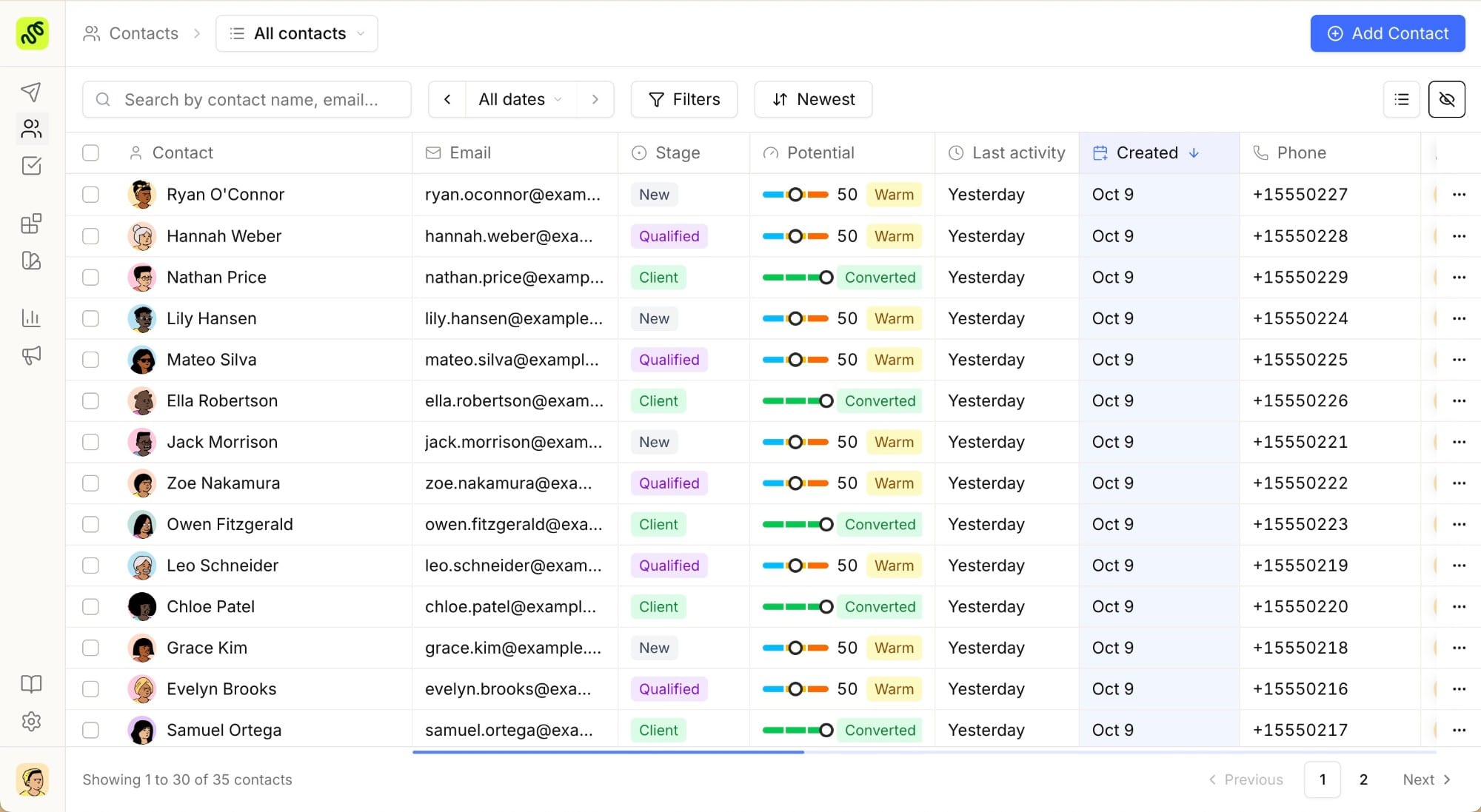
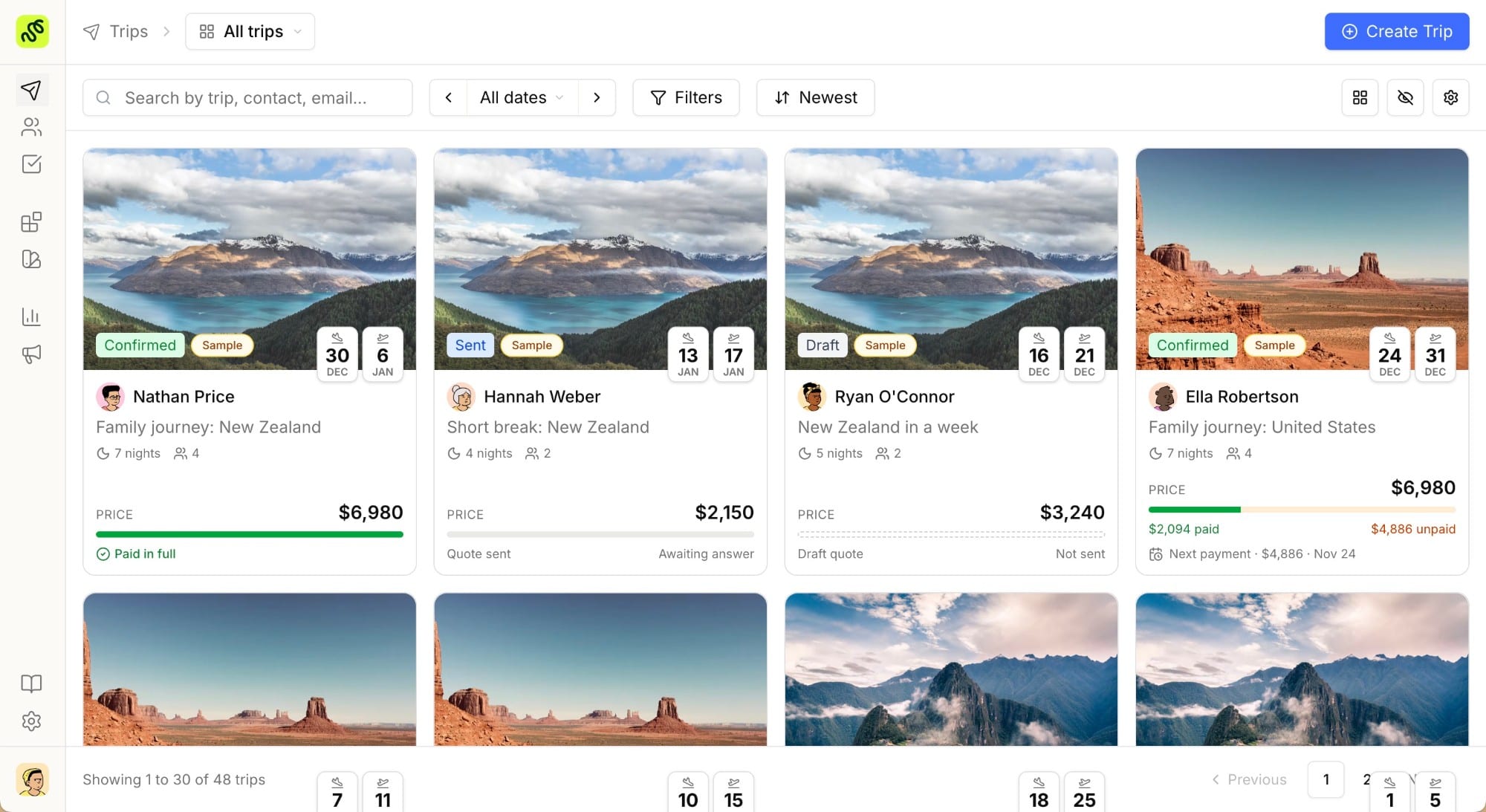
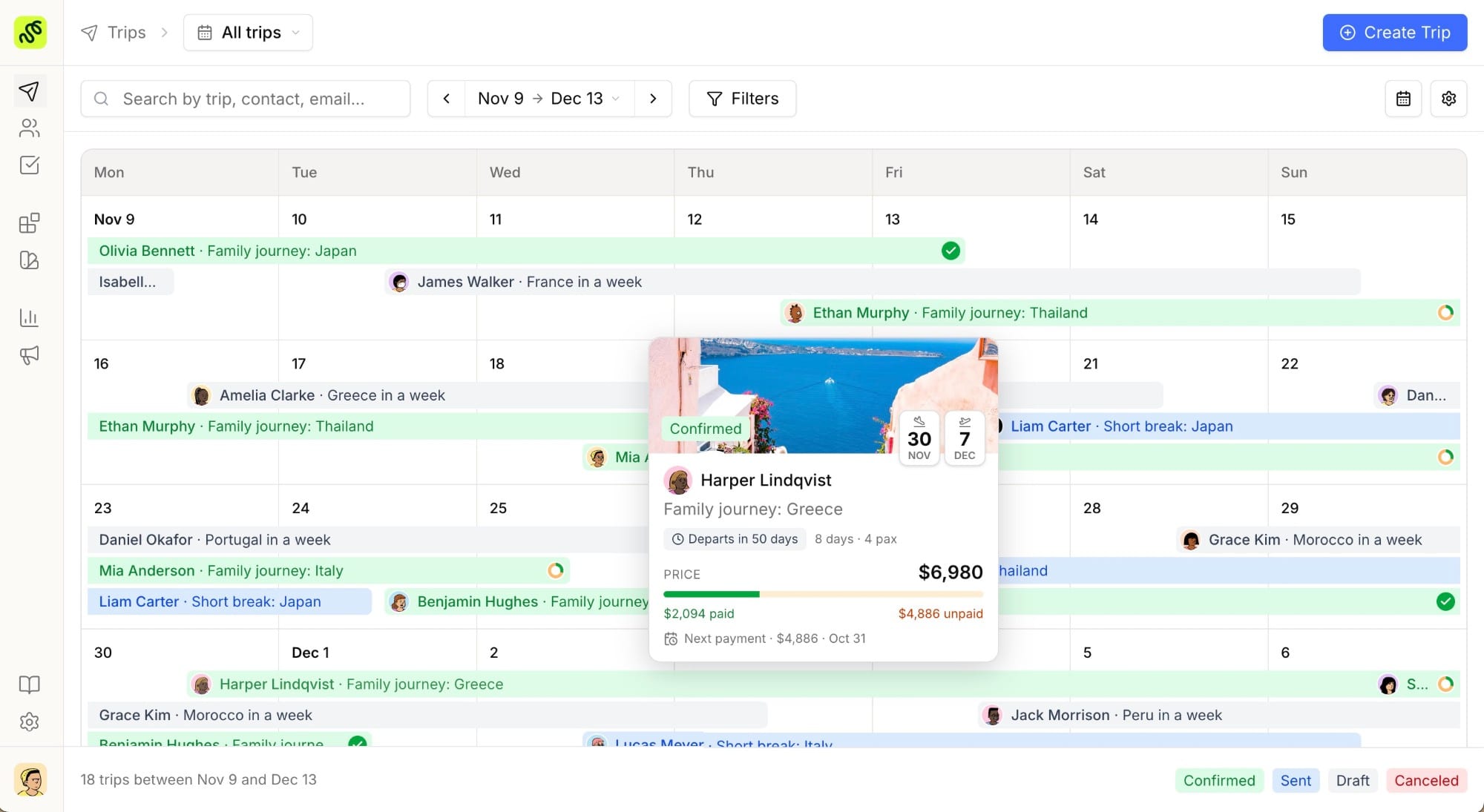
Reference something specific from the presentation: “You lit up at the idea of the private boat day: I checked and your dates are still open for it.” That beats “just checking in” every time, because it proves the follow-up is about their trip, not your pipeline. This is where a travel CRM earns its place: log what each client reacted to, what they hesitated on, and when to circle back, so the follow-up writes itself with the right context instead of a generic nudge.
Keep the cadence short and human: one message a couple of days out, one more near any real deadline, then let them come to you. In TravelBuilderPro, the proposal, the contact record, and the follow-up live in one place, so you can see at a glance what you presented, what’s still open, and what the client last responded to. Before you present at all, it’s worth running the trip through the proposal checklist so the structure is airtight and the walkthrough has nothing to apologize for.
Build and present the trip in one place
Try every feature free for 7 days. TravelBuilderPro gives you an itinerary builder, CRM, and live proposal tools in one workspace, so building the trip and presenting it happen in the same place. Start free: full access for 7 days, cancel any time before it ends.
Common questions
01Should I present a travel proposal live or just send it?
Present live for complex, high-value, or emotional trips (honeymoons, big anniversaries, multi-country builds), where reading reactions in real time is worth a 15-minute call. Send with a strong framing message for simpler trips or time-poor clients. The one option to avoid is the silent send: a proposal delivered with no context, where the client meets the price before they understand the trip.
02How long should a travel proposal presentation take?
Ten to twenty minutes for most trips. You’re not reading the itinerary line by line: you’re recapping the brief, explaining the shape of the trip, highlighting the three or four moments that make it theirs, naming your trade-offs, and framing the price. If it runs much longer, you’re over-explaining the connective days instead of curating.
03What should I say when a client says the price is too high?
Ask whether it’s the total or the value at that total: they’re different problems. If it’s value, keep selling the reasoning behind the trip. If it’s genuinely budget, adjust the trip (a night, a hotel category) rather than discounting your margin. Reshaping the itinerary protects your profitability; cutting the price just teaches the client to negotiate.
04How do I end a proposal presentation without being pushy?
Close with one specific, low-friction next step and a real reason to act: a 48-hour hold on the room that books out first, a deposit that locks the guide, or an offer to send two options side by side. Give the client a single clear action, not homework, and tie any urgency to something genuinely true rather than a manufactured deadline.
05What’s the best way to follow up after presenting a proposal?
Reference something specific the client responded to during the presentation, not a generic “just checking in.” Keep it short: one message a couple of days out, one more near any real deadline, then stop. Logging each client’s reactions in a CRM makes this easy, so every follow-up continues the conversation with the right context instead of restarting it.
Summarize this article with AI
Opens your assistant with the question already written.